
Mycotoxins in food: testing, risks, and control
Mycotoxins are invisible contaminants that can enter food before harvest, during storage, or through contaminated feed. They matter to food and supplement brands because many survive processing, contamination can vary sharply within a lot, and requirements differ by product and market. This guide explains the main mycotoxins, where testing goes wrong, and how to build a practical sampling, testing, and release workflow.
What are mycotoxins?
Mycotoxins are toxic compounds produced by certain fungi. The mold and the toxin are related, but they are not the same thing: as FAO explains, a fungal infection does not always produce a mycotoxin, and a finished product may contain a toxin even when visible mold is gone. Mycotoxins can form in crops before harvest or during storage in warm, damp conditions. Several are stable enough to persist through ordinary food processing. The World Health Organization overview describes hundreds of known mycotoxins, with a smaller group responsible for most food-safety attention.
For a brand, this changes the quality question. A visual inspection or a supplier statement can support a program, but neither replaces a risk-based test when a susceptible crop, process, or market requirement is in scope.
Which mycotoxins matter in food?
The right panel depends on the ingredients, the way they were grown and stored, the finished product, and the markets where it will be sold. These are the groups most often considered in human food programs:
| Mycotoxin or group | Common food contexts | Practical risk to manage |
|---|---|---|
| Aflatoxins B1, B2, G1, and G2 | Peanuts, corn, tree nuts, spices, rice, and some other grains; aflatoxin M1 can enter milk from contaminated feed | Aflatoxin B1 is associated with liver toxicity and liver cancer risk. FDA action levels and import controls make this a frequent release and supplier-qualification concern. |
| Ochratoxin A | Cereals, coffee, dried fruit, grapes and wine, spices, and licorice | Storage conditions are central. Kidney toxicity is well established in animals, while the human evidence is still being evaluated. |
| Deoxynivalenol (DON) | Wheat, corn, oats, barley, flour, bread, noodles, beer, and other grain products | Also called vomitoxin, DON can cause gastrointestinal effects at high exposure. Milling and processing may reduce it without removing it completely. |
| Fumonisins B1, B2, and B3 | Primarily corn and corn products, with some occurrence in other grains | Weather, storage, milling, and manufacturing can change levels. FDA publishes guidance levels for fumonisins. |
| Zearalenone (ZEN) | Corn, oats, wheat, sorghum, and rice | This Fusarium toxin has estrogenic activity and can affect reproductive systems, so it may matter in grain supply chains and export programs. |
| T-2 and HT-2 toxins | Wheat, rye, oats, barley, and other grains | These Fusarium toxins are part of newer monitoring programs and can create gastrointestinal and other health concerns. |
| Patulin | Apples, apple juice, cider, and other damaged or mold-affected fruit | Removing damaged fruit is a key control. Pasteurization does not remove patulin, so raw-material sorting and finished-product testing both matter. |
The FDA mycotoxin guidance and WHO explain the food and health context for these groups. Health effects depend on the toxin, dose, duration, and person. For product teams, the operational point is simpler: identify the plausible toxins before choosing a panel, and do not treat every crop or finished product as if it has the same risk profile.
Why mycotoxin testing is harder than a routine contaminant screen
Contamination is uneven
Mycotoxins are often concentrated in a small number of kernels, nuts, or pieces of raw material. A sample taken from one convenient location can therefore miss a contaminated pocket or overstate the lot average. USDA research on sampling variability describes sampling as the largest source of variability in many mycotoxin test procedures, ahead of grinding, subsampling, extraction, and measurement.
A defensible plan uses representative increments across the lot, keeps units or subsamples identified, and follows the receiving laboratory's sample-size and handling requirements. For powders, bars, and other finished goods, sample across production units and homogenize before the analytical subsample is taken. For bulk ingredients, the plan should cover the depth and flow of the lot rather than a single surface scoop.
Processing changes the concentration, not always the hazard
Drying, milling, sorting, extrusion, baking, and fermentation can redistribute, reduce, or concentrate a toxin. They do not create a universal rule that a processed product is safe. FDA notes, for example, that processing wheat can reduce DON without eliminating it and that pasteurization does not remove patulin from apple juice.
A finished-product result should therefore be tied to the ingredient lot, process step, and intended serving. A supplier COA for an incoming grain is useful evidence, but it does not automatically represent a blended, concentrated, or heat-processed SKU.
A number needs a decision limit
A report in parts per billion (ppb) is a measurement, not a release decision. The team still needs to know which limit, advisory level, customer specification, internal action limit, or exposure assessment applies. That limit may change by toxin, commodity, intended consumer, and destination market.
How mycotoxin tests work
Most modern multi-analyte programs use liquid chromatography coupled with tandem mass spectrometry (LC-MS/MS). The laboratory homogenizes a representative sample, extracts the target compounds, cleans the extract to reduce matrix interference, then separates and identifies each analyte through retention time and specific mass transitions. Calibration standards, blanks, spikes, and control samples show whether the batch performed as expected.
Immunoaffinity columns and ELISA-style methods can be useful for screening, especially when a program needs a quick indication for a specific toxin. They have narrower scope and different confirmation requirements than a validated quantitative LC-MS/MS method. The method should match the matrix, expected concentration, analytes, reporting limit, and decision the result will support.
The FDA's food laboratories now use a multi-mycotoxin LC-MS/MS method validated for simultaneous quantification of 12 mycotoxins, with single-analyte methods available outside that scope. Its testing methods and compliance program are a useful reference when a US regulatory question depends on method coverage.
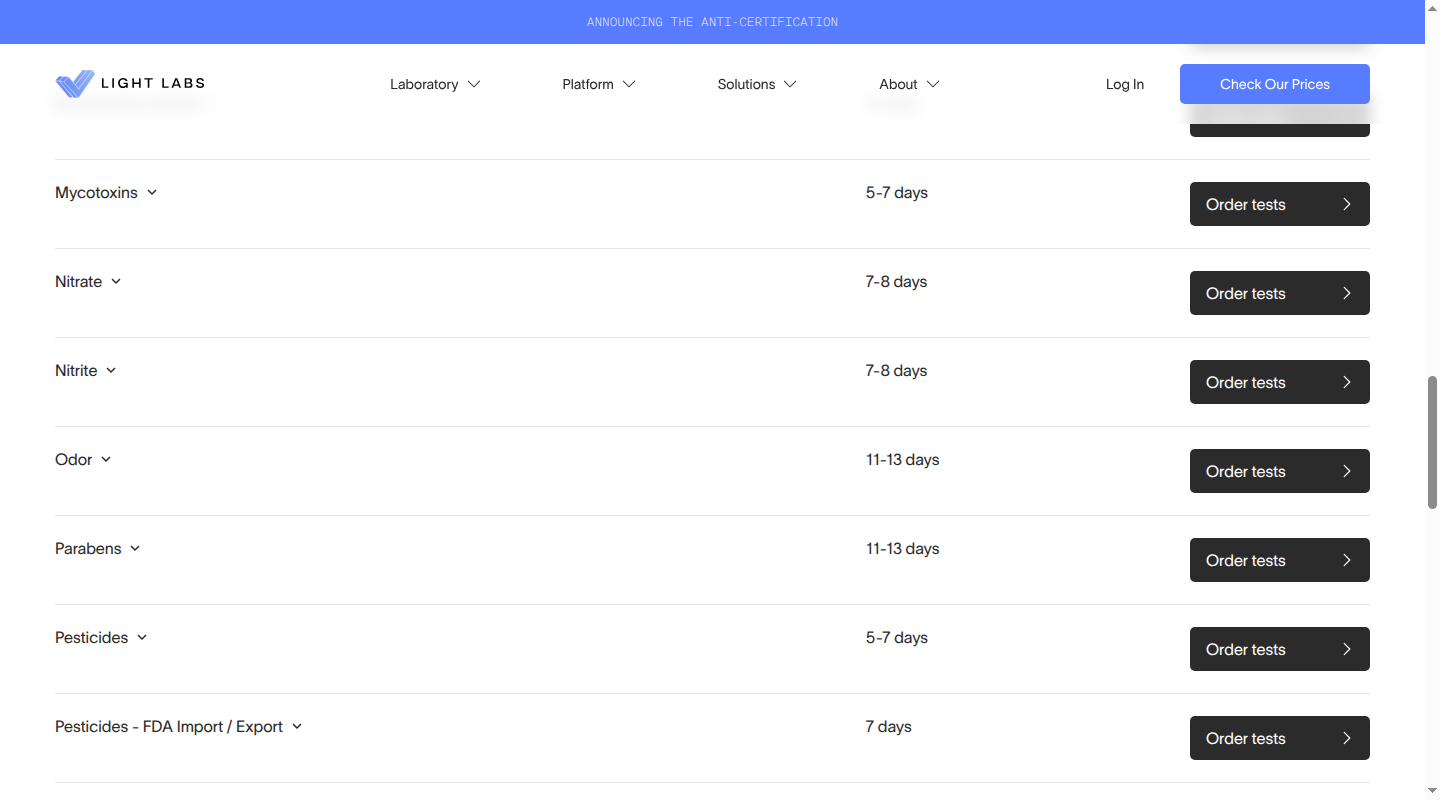
Our public testing menu lists a Mycotoxins assay that reports results in ppb and covers 13 analytes: aflatoxin B1, B2, G1, and G2; deoxynivalenol; fumonisin B1, B2, and B3; Fusarium toxin T-2; HT-2; ochratoxin A; total aflatoxins; and zearalenone. The listed turnaround is 5–7 days. For a narrower risk scope, Aflatoxins (B1, B2, G1, G2) + Ochratoxin A is listed as a five-analyte LC-MS/MS panel with a 7–10 day turnaround. Panel names and analyte counts are not interchangeable across laboratories, so compare the exact analyte list, reporting limits, matrix validation, and whether total aflatoxins is reported alongside individual congeners.
A practical mycotoxin testing workflow
A useful program connects the lab result to a decision that someone owns. This workflow works across food, beverage, and dietary supplement supply chains:
- Map the risk. List susceptible ingredients, supplier geography, harvest and storage conditions, process steps, product concentration, and intended markets. Consider infant, medical, or other sensitive-use products separately.
- Define the lot and sample plan. Decide what the result represents: an incoming ingredient lot, a production batch, a finished SKU, a supplier qualification, or a process-validation study. Use representative increments and preserve chain of custody.
- Choose the analytes and method. Select a broad panel when multiple Fusarium toxins or co-occurrence are plausible. Select a narrower panel when the ingredient and decision are specific. Confirm the method is validated for the matrix and reaches the reporting limit you need.
- Set the decision rule before testing. Document the applicable regulatory maximum, advisory level, customer specification, or internal action limit. Define who can release, hold, reject, investigate, or request a retest.
- Review the report with its quality controls. Look at units, reporting limits, recoveries, blanks, duplicates, measurement uncertainty when relevant, and any flags about matrix interference. A non-detect is meaningful only relative to the method's reporting limit.
- Trace and act on the result. If a result is elevated, hold the affected lot, check the sample and method, trace linked ingredients and SKUs, and investigate storage or process conditions. Correct the source and retest under a documented plan.
- Keep the evidence together. Store the COA, sample identity, lot details, limit used, release decision, and corrective action in the same testing record. The record should remain useful when a retailer, auditor, or regulator asks how the decision was made.
Do not use blending to dilute a lot that exceeds an applicable FDA action level. The FDA action-level guidance states that blending a food above an action level with another food does not make the final product lawful.
How mycotoxin regulations differ by market
United States
FDA has commodity-specific action levels, advisory levels, and compliance guidance rather than one limit for every mycotoxin and food. For example, the FDA's published action level for total aflatoxins in foods is 20 ppb, while other toxins such as DON and fumonisins are addressed through separate advisory or guidance levels. The limit must be matched to the commodity and use. A result that is acceptable for one ingredient may not support release of another.
The FDA updated its human-food compliance program in 2024 to add monitoring for T-2/HT-2 toxins and zearalenone and to support multi-mycotoxin analysis. That update is a signal for brands: a panel built only around aflatoxins may miss toxins that regulators and customers now expect to see in grain-based supply chains.
European Union
The EU sets maximum levels for a wider list of mycotoxins, including aflatoxins, ochratoxin A, patulin, DON, zearalenone, fumonisins, citrinin, and ergot toxins. It also specifies official sampling and analysis requirements for mycotoxins through Commission Implementing Regulation (EU) 2023/2782. The European Commission's sampling and analysis guidance is the right starting point for teams selling into the EU.
Codex and customer requirements
Codex maximum levels can provide an international reference, while a retailer or contract manufacturer may set a tighter specification. Keep the governing requirement attached to the product and market in your compliance system. A generic statement such as “passes mycotoxin testing” does not show which analytes, limits, sample, or method were used.
What to do after a positive result
A detected result is a trigger for review, not a complete root-cause analysis. Use this sequence:
- Hold and confirm scope. Place the affected lot on hold and confirm that the sample, lot number, method, and reporting units are correct.
- Review the test. Check controls, recovery, blanks, reporting limit, matrix fit, and any measurement-uncertainty rule required by the governing standard.
- Trace upstream and downstream. Identify the ingredient supplier, shared raw-material lot, co-manufacturer, production dates, and finished SKUs that may be affected.
- Investigate conditions. Review drying, temperature, humidity, storage duration, pest damage, rejected material, cleaning, and process concentration steps.
- Choose disposition. The documented decision may be release, additional sampling, rejection, rework where legally and technically appropriate, supplier corrective action, or recall escalation.
- Verify the correction. Retest a representative lot after the corrective action, then record why the evidence supports closure.
The strongest programs treat a result as supply-chain information. One out-of-spec sample can reveal a storage problem, a supplier trend, or a process step that concentrates the toxin across several products.
FAQ
Are mycotoxins the same as mold?
No. Mold is the organism; a mycotoxin is a chemical compound produced by some fungi. A mold-positive result does not identify a toxin, and a toxin result does not tell you the total amount of mold. Use the test that matches the hazard you are trying to control.
Does cooking destroy mycotoxins?
It depends on the toxin and process. Some processing steps reduce levels, while others have little effect or concentrate the toxin as moisture is removed. Treat heat as a process variable, not as a universal control. Confirm the finished product when processing changes the ingredient or concentration.
What does a non-detect result mean?
It means the analyte was not detected above the method's reporting limit in the tested sample. It does not prove zero contamination throughout the lot. The sample plan, method performance, and reporting limit determine how much confidence the result provides.
How often should a brand test for mycotoxins?
There is no universal schedule. Test when a hazard analysis, supplier change, seasonal variability, a new process, a new market, a customer requirement, or prior results make the information actionable. Higher-risk ingredients and sensitive products usually need more frequent verification than stable, low-risk products with strong supplier controls.
Are mycotoxin limits the same everywhere?
No. Limits vary by toxin, commodity, product stage, intended consumer, and jurisdiction. FDA action or advisory levels, EU maximum levels, Codex references, and customer specifications should be maintained separately and mapped to the correct SKU and market.
How Light Labs can help
Light Labs combines an ISO 17025-accredited laboratory with a testing and compliance platform. Our lab runs validated methods on LC-MS/MS and other instruments, with calibration, blanks, duplicates, and control samples built into the quality system. The Mycotoxins assay gives brands a defined panel, ppb reporting, and a listed 5–7 day turnaround; the narrower aflatoxin and ochratoxin A panel is available when that is the right scope.
The platform keeps test orders, COAs, action limits, results, and retest decisions connected by product and lot. Teams can set per-test limits, track open orders, export data, and keep a consistent record for suppliers, retailers, audits, and regulatory reviews. That turns mycotoxin testing into an operating workflow instead of a collection of disconnected PDFs. See how our compliance platform and laboratory fit into a broader quality program.
Talk with Light Labs about your testing plan if you need to scope a mycotoxin panel, build a representative sample plan, or connect results to release and compliance decisions.
Final takeaway
Mycotoxins are a crop, storage, processing, and documentation problem. A credible program does four things well:
- identifies the toxins that fit the product and market
- takes a representative sample from the right lot
- uses a matrix-validated method with a clear reporting limit
- connects the result to a documented release or corrective-action decision
When those pieces stay together, testing gives a quality team more than a number. It gives the brand a defensible way to protect product purity, meet market requirements, and build trust with customers.
Sources6 sources
- Mycotoxins and One Health - FAO
- Mycotoxins - World Health Organization
- Mycotoxins - U.S. Food and Drug Administration
- Detecting mycotoxins in agricultural commodities - USDA Agricultural Research Service
- Sampling and analysis - European Commission
- General standard for contaminants and toxins - Codex Alimentarius
Whether you’re a brand or a co-manufacturer, Light Labs helps you move faster, stay compliant, and eliminate testing bottlenecks — all from a modern, shared platform.