
Heavy metals in food and supplements: a testing and compliance guide
When a supplier or lab report says “heavy metals,” it may be naming four analytes, a broader elemental panel, or only a pass/fail conclusion. Food, supplement, and compliance teams need a more useful answer: which elements were measured, in which lot and matrix, at what reporting limit, and against which decision standard. The answer starts with the term, then follows contamination pathways, testing scope, result interpretation, and the different decisions under federal rules and California Proposition 65.
What “heavy metals” means in food quality
Heavy metals is a familiar industry phrase, not one universal legal category or a single chemical. The FDA commonly groups arsenic, lead, cadmium, and mercury under “heavy metals” or “toxic elements.” Those four are the routine panel for many food and supplement programs, yet the right scope depends on the product and its source.
The word “heavy” does not tell a team whether an element is harmful, essential, or relevant to a particular product. Iron, zinc, and copper are nutrients at appropriate levels. Lead and cadmium have no known nutritional role. Arsenic and mercury have different chemical forms with different toxicological significance. The practical choice is to name the analyte and form being managed rather than rely on a broad label.
| Element or form | Why teams pay attention | Testing question |
|---|---|---|
| Arsenic | Inorganic arsenic is generally more concerning than many organic arsenic forms. | Is the result total arsenic, or does the product need inorganic-arsenic speciation? |
| Lead | Exposure can matter at low levels, especially for products consumed by young children. | Which food category, population, and action level apply? |
| Cadmium | Plants can take it up from soil and other environmental sources. | Does the ingredient, origin, or serving pattern justify routine monitoring? |
| Mercury | The form matters, particularly for marine ingredients and fish. | Does the method report total mercury, methylmercury, or both? |
| Other elements | Antimony, chromium, nickel, thallium, and other elements may matter for a specific source or risk review. | Is a broader elemental panel justified by the ingredient, process, customer, or market? |
Where heavy-metal contamination can enter
Elements can enter a food or supplement before manufacturing, during processing, or through contact materials. The FDA identifies soil, water, and air where food is grown, raised, or processed as common environmental pathways. Natural geology and historical pollution can both contribute.
| Supply-chain point | How contamination can enter | Useful controls and records |
|---|---|---|
| Farm, harvest, or collection site | Plants can take up elements from soil, irrigation water, or air deposition. Animals can accumulate elements through feed and their environment. | Source region, crop or fish profile, soil and water history, supplier qualification, and lot traceability. |
| Agricultural and industrial history | Past use of metal-containing pesticides, mining, smelting, industrial waste, and other pollution can leave a local legacy. | Supplier risk assessment, geographic review, historical data, and risk-based incoming testing. |
| Raw-material processing | Washing, milling, drying, extraction, concentration, and blending can change the concentration or distribution of elements. | Process description, validated controls, representative raw-material and finished-product samples, and trend data. |
| Water and utilities | Contaminated process water can add elements, including arsenic. Private wells and mineral-rich water deserve particular review. | Water source, treatment records, water testing, and change control. |
| Packaging and food-contact equipment | Elements may leach from containers, utensils, or other food-contact materials under the wrong conditions. | Food-contact specifications, supplier declarations, migration or leach testing where relevant, and equipment controls. |
| Supplement components | Botanicals, algae, marine ingredients, mineral materials, clays, and other naturally sourced components can carry different element profiles. | Component specifications, qualified supplier COAs, identity and contaminant testing, and finished-batch verification. |
Examples need context. Arsenic in rice, mercury in certain fish, lead in some imported spices, and cadmium in some plants are risk patterns, not proof that every item in a category is contaminated. Source, serving pattern, and intended consumer group should drive the scope.
For dietary supplements, 21 CFR Part 111 requires component and finished-batch specifications, including limits on contamination that could adulterate a product. Each brand needs a defensible product and process specification.
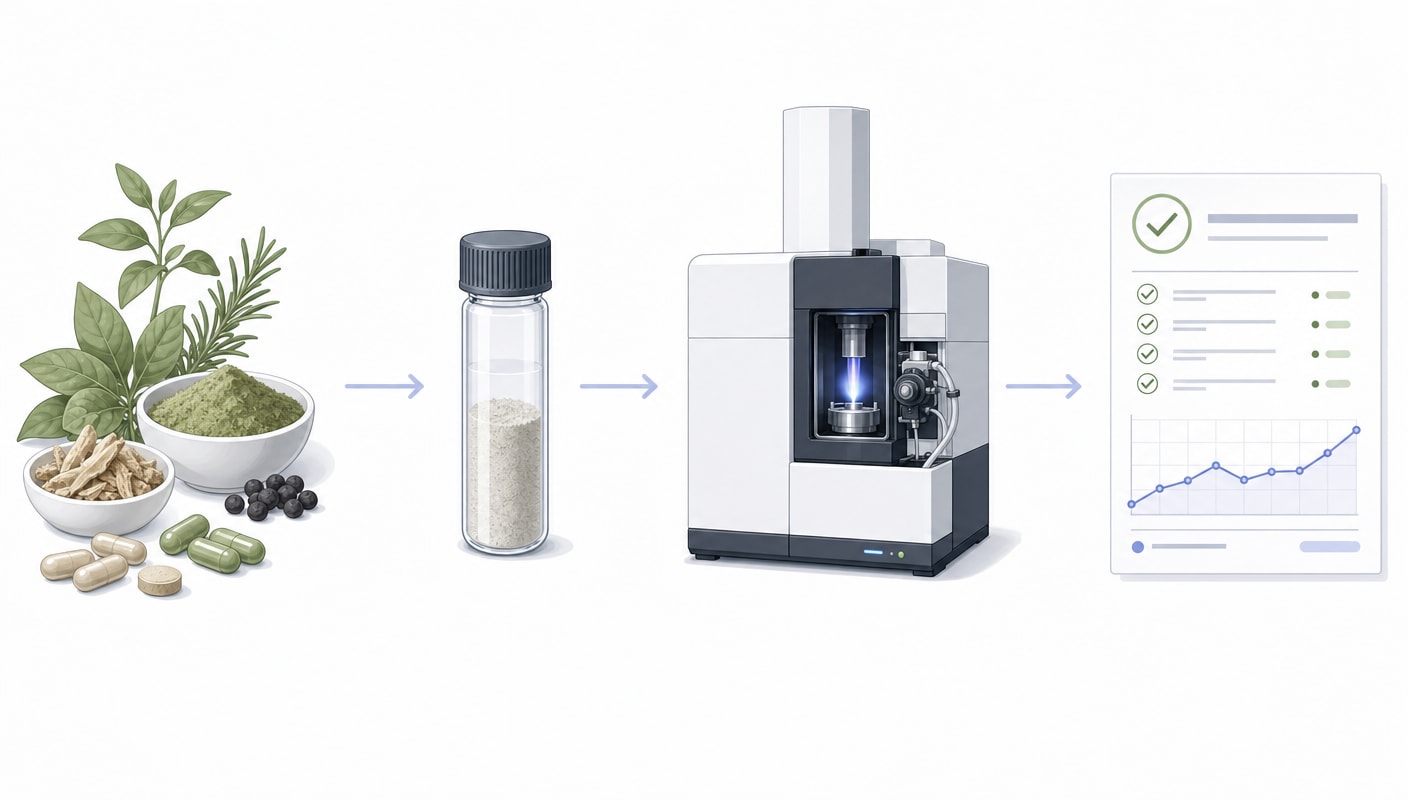
How to scope heavy-metals testing
Start with the decision the result needs to support. Supplier qualification, lot release, an investigation, market entry, and a Proposition 65 review can require different samples, analytes, and reporting limits.
Define the product and exposure
Record the product format, lot, ingredients, source regions, water inputs, processing steps, serving size, maximum labeled daily use, and intended consumer. A dry powder, liquid, gummy, capsule, fish product, and infant food do not present the same matrix or exposure question.
Choose analytes and chemical forms
The familiar starting panel is arsenic, cadmium, lead, and mercury. Expand it when the source, geography, process, customer specification, or regulatory review makes another element plausible. Ask whether arsenic should be reported as total arsenic or inorganic arsenic. Consider mercury speciation for marine products or another product-specific decision. A total result cannot answer a species-specific limit.
Choose the right sample
Incoming-ingredient testing can find a source problem early. Finished-product testing shows what the consumer receives after blending, dilution, concentration, encapsulation, or other processing. The sampling plan should address lot identity, number of units, homogenization, and uneven distribution.
Confirm method and matrix fit
ICP-MS after acid digestion is a common approach for multi-element analysis. The FDA Elemental Analysis Manual describes microwave-assisted digestion and ICP-MS for arsenic, cadmium, chromium, lead, mercury, and other elements in food. A method still needs to fit the matrix and decision limit. High-mineral, high-fat, gummy, capsule, botanical, and concentrated products can require different preparation or validation.
Ask the laboratory for:
- the method or reference procedure
- the matrix or product types covered by the method
- the analytes and chemical forms reported
- the reporting limit or limit of quantitation for each analyte
- the units and whether results are on an as-is or dry-weight basis
- quality-control, recovery, blank, and calibration information when relevant
- the laboratory’s accreditation scope for the work
Set reporting limits before testing
The reporting limit must be low enough to support the benchmark you plan to use. “Less than 1 ppm” does not mean zero. It means the analyte was below that reporting limit, which may still be too high for a product with a low exposure or action threshold.
For unit checks, 1 ppm equals 1 mg/kg and 1 µg/g, while 1 ppb equals 1 µg/kg. Keep the unit conversion with the report so a later reviewer does not compare a concentration in ppb with a daily-exposure limit without doing the math.
How to interpret a heavy-metals report
A lab concentration is an analytical result. It is not automatically a health conclusion, a legal conclusion, or a release decision.
Read the report in this order:
- Confirm the identity. Match the report to the product, lot, matrix, sample date, and chain of custody.
- Read the analyte and form. Check whether arsenic or mercury is total or speciated, and whether the reported form matches the requirement.
- Read the units and reporting limit. Record the actual value, any “less than” notation, and the reporting limit for every analyte.
- Convert concentration to product exposure. A simple calculation is
daily exposure = concentration × grams per serving × servings per day, using compatible units. For example, 0.1 µg/g in a 20 g serving taken once daily equals 2 µg per day. - Apply the correct benchmark. Compare the result with the specific food action level, supplement specification, customer limit, market requirement, or Proposition 65 exposure assessment that applies. Do not compare every product with a generic “heavy metals limit.”
- Document the decision. Keep the assumptions, benchmark, review owner, retest plan, and release, hold, or corrective-action decision with the report.
A non-detect does not prove that an element is absent. A detection does not by itself show that a product is unsafe. If a result is unexpected, near a limit, or out of trend, confirm it and review the sample and method before making a product decision. Qualified toxicology, regulatory, or legal review may be appropriate when exposure or a market obligation is uncertain.
Federal food and supplement compliance context
Federal requirements differ by product category. There is no single FDA “heavy metals” limit that applies to every food and supplement.
Food facilities use a risk-based hazard system
Under 21 CFR Part 117, covered food facilities must conduct a written hazard analysis for known or reasonably foreseeable hazards, including chemical hazards that occur naturally or are introduced unintentionally. Where a hazard requires control, the facility must implement written preventive controls. The supply-chain rule identifies raw-material sampling and testing as one possible supplier-verification activity.
That framework supports a risk-based program. It does not turn one laboratory panel into a universal federal mandate. Connect analytes, frequency, and sampling to the hazard analysis and supplier controls.
FDA action levels are product-specific
FDA action levels and guidance name the exact contaminant, form, food, and sometimes consumer group. For example, final FDA guidance lists lead action levels of 10 ppb for several processed foods intended for babies and young children under two and 20 ppb for single-ingredient root vegetables and dry infant cereals. FDA’s final guidance for inorganic arsenic in apple juice identifies a 10 ppb action level and describes it as nonbinding guidance.
Those examples cannot be transferred to an adult supplement, a different food, or total arsenic. Always use the benchmark that matches the commodity, analyte or species, population, and legal status.
Supplements need specifications and verification
Under 21 CFR Part 111, a supplement manufacturer sets component and finished-batch specifications, including contamination limits that could adulterate the product. The manufacturer must verify applicable specifications with appropriate, scientifically valid methods. A supplier COA can support component verification only when the supplier is qualified, the COA includes the method, limits, and actual results, and the relationship is periodically reconfirmed. Finished-batch verification can use a sound statistical sampling plan or every batch, with documented justification.
California Proposition 65 is an exposure question
California Proposition 65 adds a separate warning analysis. It requires businesses to provide a clear and reasonable warning for covered exposures to listed chemicals unless an applicable exemption or safe harbor applies. OEHHA describes NSRLs and MADLs as exposure levels below which the warning requirement is exempt for the relevant chemical and endpoint.
The California Attorney General’s guidance makes the distinction explicit: Proposition 65 warning requirements are independent of federal composition standards and are tied to exposure from a product, not simply the concentration in the product. A result therefore needs product use, serving size, frequency, route, chemical form, and the applicable safe-harbor or risk-assessment basis. Detection alone does not automatically require a warning.
This is why a federal pass and a California warning review can lead to different next steps. A federal action level may address a particular food and contaminant concentration. Proposition 65 asks what exposure the product causes in California and whether that exposure is above the relevant threshold. A laboratory report supplies an input, not the warning decision.
Our Prop 65 testing guide explains the difference between targeted analyte testing, exposure assessment, and a warning decision.
FAQ
Is “heavy metals” one chemical or one legal test?
No. It is an umbrella phrase. Many routine panels include arsenic, cadmium, lead, and mercury, while a product-specific program may include other elements or chemical forms. The report should name every analyte, form, unit, and reporting limit.
Are heavy metals present in every food or supplement?
Elements occur naturally in the environment, so trace levels can be possible. Levels vary with the ingredient, origin, process, packaging, serving size, and sampling. A detection alone does not determine whether a product is unsafe or out of specification.
What four elements are usually in a heavy-metals panel?
Arsenic, cadmium, lead, and mercury are common starting points. That panel is not a universal requirement. Source materials, product category, consumer group, customer specifications, and market requirements may justify additional elements or speciation.
Does a “pass” on a COA prove a product is safe?
No. Review what the COA tested, its reporting limits, lot identity, method, matrix, and benchmark. “Pass” is meaningful only against a named specification that fits the product and decision. It also does not replace a broader hazard analysis or supplier-control program.
Does detecting a heavy metal automatically require a Proposition 65 warning?
No. Proposition 65 is based on exposure to listed chemicals and applicable thresholds. Product use, serving size, route, chemical form, and safe-harbor analysis matter. Brands should obtain qualified regulatory, toxicology, and legal advice for a product-specific warning decision.
What is the difference between total and inorganic arsenic?
Total arsenic combines multiple chemical forms. Inorganic arsenic is generally more toxic than many organic forms, so a total-arsenic result may not answer a requirement that is written for inorganic arsenic. Use a validated speciation method when the product or benchmark calls for it.
How often should a brand test for heavy metals?
Frequency should follow documented risk. High-risk ingredients, new suppliers, new source regions, variable harvests, infant or child products, and unusual results can justify more frequent testing. Lower-risk products may use periodic finished-batch verification supported by supplier controls and trend data. The plan should explain why the frequency is appropriate.
How Light Labs helps teams manage heavy-metals testing
Light Labs combines an ISO 17025-accredited lab with a software and compliance workflow. Our Heavy Metals assay is listed for food samples and measures arsenic, cadmium, lead, and mercury, with ppb reporting, acid digestion, commonly ICP-MS analysis, and a listed three-day turnaround. The exact scope and timeline should be matched to the supplement matrix and project before ordering.
When a product needs a narrower answer, our elemental testing menu includes an Inorganic Arsenic assay and other elemental work. Teams can connect the method, lot, result, action limit, COA, retest, and release decision in our compliance workflow, rather than leaving the interpretation in separate spreadsheets and PDFs.
If you need to scope a heavy-metals program for a food, supplement, ingredient, or California exposure review, start with our testing menu.
Final takeaway
Treat “heavy metals” as the beginning of a testing question, not the answer. Name the elements and forms, trace plausible sources, choose a representative matrix and a method with fit-for-purpose reporting limits, and convert results into the exposure or specification decision that applies.
Federal food and supplement programs are risk- and product-specific. Proposition 65 adds an exposure-based California warning analysis. Document those distinctions alongside the lab result so the decision is proportionate and explainable.
Sources12 sources
- FDA: Environmental contaminants in food - U.S. Food and Drug Administration
- FDA: Toxic elements in foods and foodware - U.S. Food and Drug Administration
- FDA Elemental Analysis Manual - U.S. Food and Drug Administration
- 21 CFR 111.70: Dietary supplement specifications - Electronic Code of Federal Regulations
- 21 CFR 111.75: Verifying dietary supplement specifications - Electronic Code of Federal Regulations
- 21 CFR 117.130: Food hazard analysis - Electronic Code of Federal Regulations
- 21 CFR 117.135: Food preventive controls - Electronic Code of Federal Regulations
- 21 CFR 117.410: Supply-chain verification - Electronic Code of Federal Regulations
- FDA lead action levels for processed baby and young-child food - U.S. Food and Drug Administration
- FDA inorganic arsenic action level for apple juice - U.S. Food and Drug Administration
- OEHHA Proposition 65 safe-harbor levels - California Office of Environmental Health Hazard Assessment
- California Attorney General Proposition 65 FAQ - California Department of Justice
Whether you’re a brand or a co-manufacturer, Light Labs helps you move faster, stay compliant, and eliminate testing bottlenecks — all from a modern, shared platform.