
Root cause analysis template for food and supplement quality
Quality incidents rarely arrive with a complete explanation. A failed contaminant result, an allergen cross-contact finding, or a missing certificate of analysis (COA) can tempt a team to write “operator error” and move on. We built the root cause analysis template below for food and supplement quality teams that need an auditable path from first signal to verified corrective action. Copy it into your QMS, document, or spreadsheet, then use the prompts to protect product, test hypotheses, and prevent a repeat.
What a useful root cause analysis captures
A root cause analysis (RCA) is a structured investigation. It connects the event to evidence, separates immediate correction from corrective action, and records how we know the fix worked. The FDA’s food-safety RCA resource recommends a qualified team, a precise problem description, records and laboratory data, cause-analysis tools, and verification of the actions taken.
For a food or supplement incident, our template captures eight things:
- The event and its scope. What happened, where, when, and which products, lots, suppliers, or customers may be involved.
- Containment. How we hold product, stop a process, protect consumers, and control records while we investigate.
- A factual timeline. What happened before, during, and after the signal, with a record for every important step.
- Evidence. Test results, methods, sample details, COAs, batch records, environmental data, interviews, photos, and observations.
- Causal analysis. The method we used, the causes we considered, and the evidence that confirms or rules out each one.
- The root-cause decision. A statement that explains the mechanism, the failed control, and the evidence, rather than naming a person.
- CAPA and change control. Actions that correct affected product and actions that reduce the chance of recurrence or occurrence elsewhere.
- Effectiveness and closure. A measurable check, a reviewer, and a decision to close, extend, or reopen the investigation.
ISO’s process-approach guidance describes corrective action in the same sequence: identify and eliminate root causes, implement the change, and evaluate its effectiveness. That is why “we retrained the operator” is an action to assess, not a complete RCA.
The tables below copy cleanly into Excel, Google Sheets, Word, or a digital QMS. If your system calls this a root cause analysis report, incident investigation, or corrective-action form, keep the same fields and evidence links.
Root cause analysis template (copy and use)
1. Event and scope
| Field | Record |
|---|---|
| RCA ID and title | [unique ID]: [short, factual title] |
| Date opened / due date | [date] / [date] |
| Owner and investigation team | [QA owner] / [names and functions] |
| Trigger | [complaint, out-of-specification result, audit finding, environmental result, supplier issue, near miss, or other] |
| Product and SKU | [product name, format, SKU] |
| Finished batch, raw-material lot, supplier, and site | [lot codes, supplier, manufacturing site] |
| Requirement or expected condition | [specification, action limit, label claim, SOP step, preventive control, or customer requirement] |
| Actual observation | [measured result or observed failure, with date, unit, method, and sample ID] |
| Impact and population | [quantity, distribution status, markets, customers, or consumers potentially affected] |
| Initial risk classification and rationale | [food safety, quality, compliance, continuity, or customer risk; explain the rating] |
Write the problem as one measurable sentence. A useful pattern is: “[Product or process] produced [observed result] instead of [expected result] at [place and time].” Keep causes out of this field. “The operator skipped the check” is a hypothesis; “the sanitation verification record was blank for line 2 on 14 August” is an observation.
2. Immediate containment and disposition
| Action | Owner | Completed | Evidence or decision |
|---|---|---|---|
| Place affected product, material, or process on hold | [name] | [date/time] | [hold record or system status] |
| Stop or isolate the suspected source | [name] | [date/time] | [line, supplier, equipment, or ingredient status] |
| Trace affected lots, work-in-process, shipments, and customers | [name] | [date/time] | [trace report and boundaries] |
| Check whether other products, sites, or time periods are affected | [name] | [date/time] | [extent-of-condition review] |
| Evaluate product safety and choose disposition | [QA approver] | [date/time] | [release, reject, rework, return, destroy, or continued hold] |
| Apply temporary controls while the RCA runs | [name] | [date/time] | [extra test, inspection, segregation, or process control] |
| Make required internal, customer, or regulatory notifications | [name] | [date/time] | [notification record or reason not required] |
A correction fixes the immediate condition. Corrective action addresses why the condition occurred and how we will stop it from recurring. Do both when the risk warrants it. A retest does not release a held lot by itself; record the scientific reason for the retest and the final disposition.
For U.S. facilities covered by 21 CFR 117.150, written corrective-action procedures must identify and correct implementation problems, reduce the likelihood of recurrence, evaluate affected food, prevent affected food from entering commerce when we cannot ensure it is not adulterated or misbranded, and document the actions. The regulation allows a timely correction for a minor, isolated problem that does not directly affect product safety. Read the rule and align this record with your food-safety plan and jurisdiction.
3. Evidence log and timeline
Evidence log
| ID | Source and record location | What it can prove | Limitations or gaps |
|---|---|---|---|
| E-01 | [lab report, COA, batch record, SOP, interview, photo, system log] | [specific fact] | [missing data, sampling limit, or uncertainty] |
| E-02 | [source] | [specific fact] | [limitation] |
| E-03 | [source] | [specific fact] | [limitation] |
For laboratory evidence, record the sample ID, lot, matrix, collection time, sampler, chain of custody, method, laboratory, result units, specification or action limit, detection or quantitation limit, and whether the test was a screening, confirmation, or release test. Keep the original report and any amended report together.
Timeline
| Date/time | Event or decision | Record or witness | Why it matters |
|---|---|---|---|
[timestamp] | [material received, process step, sample collected, result reported, or action taken] | [record/person] | [connection to the event] |
[timestamp] | [event] | [record/person] | [connection] |
[timestamp] | [event] | [record/person] | [connection] |
Build the timeline before the group debates causes. It often reveals a change in supplier, equipment, formulation, cleaning, sampling, or record review that a meeting-room explanation misses.
4. Analyze possible causes
| Cause ID | Potential cause | Prediction if true | Evidence checked | Result |
|---|---|---|---|---|
| C-01 | [supplier, material, method, machine, measurement, people, environment, or management-system factor] | [what we would expect to see] | [record, test, observation, or interview] | [confirmed, refuted, or still open] |
| C-02 | [potential cause] | [prediction] | [evidence] | [status] |
| C-03 | [potential cause] | [prediction] | [evidence] | [status] |
Choose a method that fits the shape of the problem:
| Method | Use it when | Guardrail |
|---|---|---|
| 5 Whys | One main cause-and-effect chain is visible. | Stop when the answer is an evidence-backed, controllable condition. Five is a prompt, not a quota. |
| Fishbone (Ishikawa) | Several categories could contribute, such as material, method, machine, measurement, people, or environment. | Treat branches as hypotheses and test them; a brainstorm is not proof. |
| Fault tree | A high-risk top event could result from different combinations of failures. | State the logic and data for each branch. |
| Barrier or escape analysis | A control should have prevented or detected the event, but the event passed through. | Record both the cause of the failure and why the control did not catch it. |
| Trend or Pareto review | We have repeated incidents, supplier results, complaints, or near misses. | Use the trend to prioritize investigation; it does not prove causation on its own. |
| 8D or DMAIC | A cross-functional, supplier, or complex process problem needs a formal sequence and milestones. | Keep the RCA evidence and CAPA decisions linked to the same record. |
Use five whys inside a branch of a fishbone when the causes are not linear. Ask “why did the system allow this?” as well as “why did the event happen?” That keeps the analysis focused on process design, specifications, training, measurement, workload, and change control instead of blame.
5. State and verify the root cause
Use a sentence that another investigator can test:
Because [system condition or failed control], [failure mechanism] occurred when [specific circumstance], as shown by [evidence IDs].
| Decision field | Record |
|---|---|
| Confirmed root cause(s) | [one or more evidence-backed statements] |
| Direct cause(s) | [immediate physical, chemical, biological, or process condition] |
| Contributing cause(s) | [conditions that increased likelihood or severity] |
| Escape or detection failure | [why the control did not prevent or detect the issue] |
| Extent of condition | [other lots, SKUs, lines, suppliers, sites, or time periods checked] |
| Alternative causes ruled out | [cause IDs and evidence] |
| Evidence still needed | [open question, owner, and due date] |
Do not close the RCA with “human error” alone. If a person made a mistake, ask why the procedure, interface, workload, training, supervision, or detection control made that mistake likely and allowed it to pass. The root cause must point to a change we can make and verify.
6. Corrective and preventive action plan
| Action type | Cause addressed | Action and deliverable | Owner | Due date | Change control or validation needed? | Success measure |
|---|---|---|---|---|---|---|
| Correction | [immediate condition] | [rework, segregation, sanitation, label correction, or disposition] | [name] | [date] | [yes/no and record] | [condition corrected] |
| Corrective action | [confirmed root cause] | [SOP, equipment, supplier agreement, specification, sampling plan, or workflow change] | [name] | [date] | [yes/no and record] | [measurable outcome] |
| Preventive action | [risk that could occur elsewhere] | [apply learning to other products, sites, or suppliers] | [name] | [date] | [yes/no and record] | [measurable outcome] |
Each action needs an owner, date, deliverable, and acceptance measure. “Train the team” is incomplete until we define the procedure or control that changed and the evidence that people can perform it. Add supplier corrective action, requalification, testing, or audit requirements when the source is outside our facility.
7. Effectiveness check and closure
| Check | Record |
|---|---|
| What will be measured? | [result, defect rate, complaint rate, COA match, audit finding, trend, or control performance] |
| Baseline and target | [baseline] / [target] |
| Sample size and observation period | [number of lots, batches, shifts, or days] |
| Data source and method | [system, test, audit, review, or inspection] |
| Reviewer and review date | [independent QA reviewer] / [date] |
| Result | [met, partially met, or did not meet] |
| Decision | [close, extend, reopen, or escalate] |
| Closure evidence | [record links, reports, approvals] |
Plan this check when we write the action, not after the due date. An effectiveness check asks whether the changed control works under normal conditions and whether the issue appears elsewhere. If the target is missed, reopen the analysis instead of lowering the target.
8. Approval and record control
| Field | Record |
|---|---|
| QA approval | [name, signature or electronic approval, date] |
| Operations or manufacturing approval | [name and date] |
| Supplier or co-manufacturer response | [name, CAPA reference, date] |
| Linked records | [COAs, lab reports, batch records, change controls, training, notifications] |
| Retention and access | [system, retention period, permissions] |
| Lessons applied elsewhere | [products, sites, suppliers, or procedures updated] |
A complete record lets someone who was not in the investigation see the problem, evidence, decision, action, and verification without rebuilding the story from email.
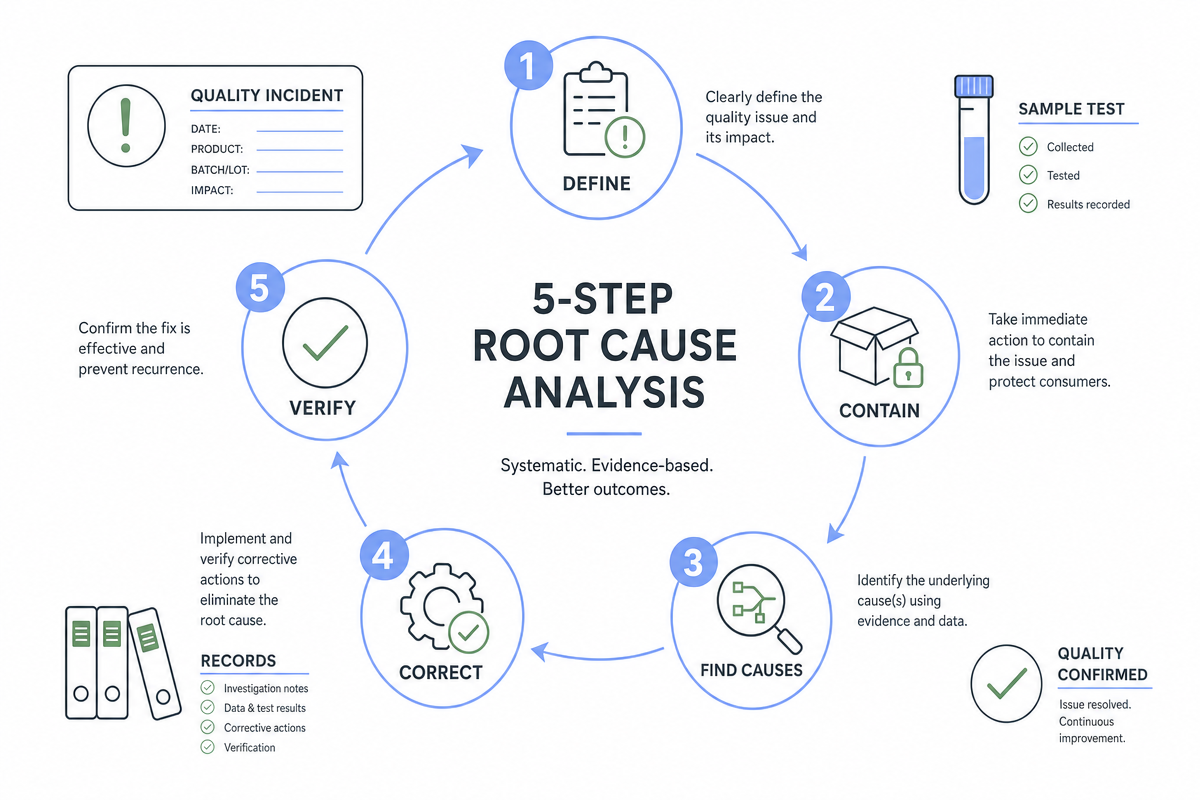
Treat the record as a closed loop: define the event, contain it, find causes, correct the system, and verify the result.
How to use the template in a real investigation
- Triage first. Protect people and product before debating the explanation. Put affected lots on hold, preserve samples and records, and establish who can release or dispose of product.
- Define the boundary. Name the exact product, lot, line, supplier, method, time window, requirement, and measured result. Add “is” and “is not” facts so the team does not investigate an unlimited problem.
- Collect original evidence. Use source records and retained samples where possible. Confirm sample identity, matrix, method, units, limits, calculations, and chain of custody before treating a result as causal.
- Map the process. Walk from material receipt through production, testing, release, distribution, and customer use. Mark each control, handoff, decision, and data gap.
- Generate and test causes. Use a fishbone or fault tree to make branches visible, then use five whys or targeted testing to test each branch. Label causes as confirmed, refuted, or open.
- Check extent of condition. Search other lots, SKUs, sites, suppliers, shifts, methods, and prior complaints. A local fix can fail when the same system is used elsewhere.
- Write CAPA and verify it. Link every action to a confirmed cause, assign an owner and due date, define the acceptance measure, and schedule an independent effectiveness review.
Worked example: an out-of-limit contaminant result
This is a fictional example. The action limit and disposition must come from the product specification, risk assessment, and applicable requirements.
A finished supplement lot reports a contaminant result above the brand’s approved action limit. We place the lot on hold and confirm the sample identity and method. The investigation finds:
- The supplier COA was marked pass, but its lot number did not match the material received.
- The supplier changed its source without triggering a change notification.
- Receiving staff had no required check for COA-to-lot matching.
- The brand had no trend of results by supplier lot, so an earlier shift was not visible.
The root-cause statement is: Because the supplier-change and COA-to-lot controls were not defined, a source change entered production without verification, allowing the contaminant result to exceed the approved action limit, as shown by the unmatched COA and supplier records.
The CAPA record then includes:
- Hold and evaluate all potentially affected lots, including retained samples and distribution records.
- Require a supplier change notification and lot-matched COA before receipt or release.
- Add independent testing for the next three supplier lots, with a risk-based ongoing frequency.
- Update the approved-supplier record, receiving checklist, and quality agreement.
- Trend results by supplier, source, lot, and product; escalate a near-limit trend before an out-of-limit result.
- Verify effectiveness after the defined number of lots and review the control at the next supplier audit.
The example shows why “retest the finished product” is rarely a complete answer. The test result matters, yet the durable fix sits in supplier change control, receiving evidence, testing strategy, and trend visibility.
Common template mistakes and the guardrail for each
| Mistake | Guardrail |
|---|---|
| Starting with a preferred explanation | Record facts and a timeline before naming causes. |
| Treating a COA as proof without checking it | Match supplier, lot, matrix, method, units, limits, and actual result. |
| Using five whys as a ritual | Stop when evidence supports a controllable cause; branch when causes are independent. |
| Stopping at a person or shift | Examine procedure design, tools, workload, training, supervision, and detection controls. |
| Retesting until a pass appears | Define when confirmation testing is valid and document the disposition of every result. |
| Fixing one lot and ignoring the extent | Search other lots, products, sites, suppliers, and prior signals. |
| Closing CAPA at implementation | Require an independent effectiveness check against a stated target. |
| Filing records in separate systems | Link the RCA to the lab report, COA, batch record, change control, and release decision. |
FAQ
What is a root cause analysis template?
It is a structured record for defining a problem, containing affected product, collecting evidence, testing causes, assigning corrective and preventive actions, and verifying that the actions worked. A useful template records decisions and evidence, rather than only a fishbone or five-whys worksheet.
Is root cause analysis the same as CAPA?
No. RCA determines why a nonconformity happened and why a control failed. CAPA turns those findings into corrections, corrective actions, preventive actions, owners, dates, and effectiveness checks. We link the RCA and CAPA in one record so the action addresses the evidence.
How many whys should we ask?
Ask until the answer is an evidence-backed condition that we can control and verify. Five is a reminder to keep going past the first symptom. If the problem branches, use a fishbone, fault tree, or barrier analysis and apply whys to each relevant branch.
When should we retest a failed sample?
Retest when a written procedure and a scientific rationale support it, such as a documented sampling or laboratory issue. Confirm sample identity, matrix, method, calculations, and specification first. Keep the original result, rationale, and final disposition in the record; a passing retest does not erase an earlier result.
Who should complete the investigation?
A qualified, cross-functional team should include the process owner, QA, and the people who understand the material, method, equipment, supplier, or customer impact. An independent QA reviewer should approve the root-cause decision and effectiveness check.
Put your RCA evidence to work with Light Labs
RCA decisions are only as strong as the evidence trail behind them. At Light Labs, our ISO 17025-accredited lab and compliance platform keep sample details, methods, results, action limits, COAs, and retest decisions connected to the product and lot. Our lab uses ICP-MS, LC-MS/MS, HPLC, and GC-MS methods, with calibration and control checks built into the quality program.
Our software provides a testing system of record, real-time sample tracking, out-of-specification retest notifications, configurable action limits, and one-click COA exports. That gives QA, operations, suppliers, and co-manufacturers the same source record while an investigation is open. You can see our testing platform or start a test with Light Labs.
Final takeaway
A root cause analysis template should make the investigation harder to close early and easier to defend later. Define the event with measurable facts, contain affected product, connect every conclusion to evidence, test causes instead of assuming them, and tie each CAPA action to an owner and an effectiveness measure. When the test result, COA, lot, decision, and corrective action stay together, quality teams can prevent the next incident instead of documenting the last one.
Sources3 sources
- Strengthening Food Safety Through Root Cause Analysis - U.S. Food and Drug Administration
- ISO 9001:2015 - Process approach - International Organization for Standardization
- 21 CFR 117.150 - Establishment and implementation of corrective action procedures - Cornell Legal Information Institute
Whether you’re a brand or a co-manufacturer, Light Labs helps you move faster, stay compliant, and eliminate testing bottlenecks — all from a modern, shared platform.