
Out-of-specification investigation: A practical guide for food and supplement brands
An out-of-specification (OOS) result can stop a batch, delay a launch, or reveal a supplier problem. Treating it as a request to “run it again” destroys the evidence needed to protect consumers and defend a release decision. We use a disciplined sequence: preserve the original data, test whether a laboratory event caused the result, then investigate the material and process before making a disposition decision. Food and supplement teams can apply the same sequence, with clear handoffs when testing is outsourced.
What an out-of-specification result means
An OOS result is a reported test value outside an approved specification or acceptance criterion. The specification may cover identity, strength, purity, composition, moisture, contaminants, microbiological limits, packaging, or another quality characteristic. Examples include:
- Lead above the product’s action limit in a heavy-metals panel
- An active ingredient assay below the approved label-claim range
- A finished product that fails an identity test
- A pathogen detected where the specification requires absence
- Moisture, pH, fill weight, or another in-process value outside its limit
An OOS is defined by the limit, not by how surprising the number looks. A result can be close to a limit and still be OOS, while a result far from a historical average can remain within specification.
Two related signals deserve their own investigation path:
- Out of trend (OOT): a result that remains within specification but breaks the expected pattern for the product, method, or stability program. OOT can be an early warning of drift and does not automatically make a batch OOS.
- Atypical or unexpected result: a new contaminant, an unexplained chromatographic peak, or a result above an internal alert level. It may not violate a formal specification, yet it can indicate a method, supplier, or process problem.
Log all three signals. If the team waits until a formal limit is breached, it may lose the chance to stop a recurring issue early.
The regulatory baseline for brands and laboratories
The right investigation record depends on the product category. FDA’s 2022 OOS guidance is written for chemistry-based testing of drugs regulated by the Center for Drug Evaluation and Research (CDER). It is a useful model for many controlled laboratory investigations, yet it does not replace the requirements that apply to foods or dietary supplements.
| Product or operation | What the rule or guidance requires | What your OOS procedure should do |
|---|---|---|
| Drugs and active pharmaceutical ingredients | FDA’s OOS guidance describes a Phase I laboratory assessment followed by a Phase II full-scale investigation when no clear laboratory cause is found. 21 CFR 211.192 requires a thorough investigation of unexplained discrepancies and failures, including an assessment of related batches and a written conclusion. | Keep the lot on hold, preserve all data, complete both phases when needed, and give the quality unit the evidence for release or rejection. |
| Dietary supplements | Under 21 CFR 111.75, specifications cover identity, purity, strength, composition, and contamination limits. The rule requires a corrective-action plan when a specification is not met. 21 CFR 111.113 requires quality-control personnel to conduct a material review and make a disposition decision. | Hold the material or batch, document the material review, and reject it unless quality control approves a permitted treatment, adjustment, or reprocessing. |
| Conventional foods at facilities covered by preventive controls | 21 CFR 117.150 requires written corrective-action procedures, evaluation of affected food for safety, and prevention of adulterated or misbranded food from entering commerce. Product and environmental testing procedures under §117.165 must include the method, sampling, laboratory, and corrective action. | Link the OOS event to the food-safety plan, evaluate every affected lot, document corrections and corrective actions, and reassess the plan when the control may be ineffective. |
| Contract laboratories | FDA’s OOS guidance says a contract laboratory should send its data, findings, and supporting documentation to the manufacturing firm’s quality unit when no causative laboratory error is identified. | Define notification time, sample retention, raw-data access, retest approval, COA handling, and decision ownership in the quality agreement. |
When a laboratory activity or result does not conform to its procedure or an agreed customer requirement, ISO 17025 treats it as nonconforming work. Build the OOS procedure around the standard’s nonconforming-work controls, so the lab can stop work, withhold a report, evaluate impact on previous results, notify the customer, and authorize resumption. Those controls make the investigation traceable even when the brand and the lab use different systems.
A practical OOS investigation workflow
1. Contain the event and preserve evidence
The analyst or reviewer should notify the laboratory supervisor and the brand’s quality contact as soon as the result is recognized. Before changing anything:
- Place the lot, component, or finished product on hold. Stop release, shipment, rework, or label approval until quality control authorizes the next step.
- Assign a unique investigation number and record the date, test, method, specification version, sample ID, lot, analyst, instrument, and result with units.
- Preserve the original sample, composite, aliquots, test solutions, standards, chromatograms, spectra, instrument files, calculations, and audit-trail records while they remain stable.
- Record storage and transport conditions, chain of custody, and who has access to the material.
- Check whether the result affects product already distributed, work in progress, other SKUs, or a shared raw-material lot.
The first hours matter. FDA advises beginning the accuracy assessment before test preparations are discarded whenever possible, so a suspected dilution, instrument, or sample-handling error can be tested using the original preparation.
2. Complete Phase I, the laboratory investigation
Phase I asks a narrow question: Is there documented evidence that a laboratory event caused this result? It is an evidence review, not a search for a convenient explanation.
Use a checklist that covers:
- Specification and method: Confirm the current approved limit, units, rounding rule, decision rule, method version, and whether the test is qualitative, quantitative, or a defined replicate result.
- Sample identity and sampling: Verify labels, lot numbers, sample amount, sampling location, homogenization, representativeness, storage, and holding time. A correct analysis of the wrong or poorly collected sample is still a quality event.
- Analyst execution: Ask the analyst to walk through the method from weighing and extraction through dilution, instrument setup, integration, and calculations. Look for documented spills, incomplete transfers, wrong volumes, transcription errors, or unauthorized changes.
- Raw data and calculations: Review chromatograms, spectra, integration parameters, worksheets, formulas, data transfers, and LIMS audit trails. Recalculate independently.
- Instrument and system suitability: Check calibration, maintenance, alarms, control charts, blanks, duplicates, reference-standard responses, system-suitability criteria, and any other runs performed during the suspect period. If a system was out of control, identify all results that could be affected.
- Reagents and standards: Confirm identity, lot, preparation, expiry, storage, certificates, and suitability for the method.
- Method performance: Compare controls and variability with method validation or verification data. Check environmental conditions and glassware where they can influence the result.
If the team finds a specific, documented laboratory cause, record the cause, preserve the original result, correct the system, and repeat the test under the approved method. The repeat does not erase the original record. FDA’s OOS guidance says an OOS result should be invalidated only when an observed test event can reasonably be shown to have caused it.
If the review cannot establish a cause, do not label the event “analyst error” or “random variation.” Move to the full investigation and keep the original result in the decision set.
3. Use an explicit decision gate
At the end of Phase I, write one of these evidence-based conclusions:
| Phase I conclusion | Next action |
|---|---|
| A clear laboratory cause is proven | Correct the laboratory issue, perform the approved repeat, assess other results exposed to the same cause, and document why the original result is invalid. |
| No laboratory cause, and additional data confirm the failure | Treat the event as a material or batch failure. Continue the impact assessment, disposition the lot, and start CAPA. |
| No laboratory cause, and additional data do not confirm the failure | Keep the OOS result in the record. Complete the full investigation and let quality control decide whether the evidence supports release, rejection, or further action. |
A passing repeat by itself never moves an event into the first row.
4. Expand to Phase II, the material and process investigation
When the laboratory review does not identify a cause, the quality unit should lead a full investigation with the people who can explain how the material was made and sampled. Include manufacturing, process development, engineering, maintenance, procurement, the supplier, and the co-manufacturer when their work could be involved.
Review the evidence in this order:
- Batch and process records: Weighing, additions, mixing time and speed, temperatures, hold times, line clearance, yields, in-process controls, deviations, and operator notes.
- Sampling and storage: Where and when samples were taken, who collected them, how they were mixed or split, and whether storage or transport could change the analyte.
- Raw materials and suppliers: Incoming identity and contaminant results, supplier COAs, lot changes, material substitutions, transport conditions, and supplier deviations.
- Equipment and facility: Calibration status, maintenance, cleaning, cross-contamination controls, environmental monitoring, utilities, and alarms.
- History and scope: Previous OOS, OOT, complaints, returns, stability data, trend charts, and results for other lots, products, sites, or instruments.
- Distributed inventory: Decide whether any released product, work in progress, or customer stock shares the material, process step, or failure mode.
Use a root-cause method that fits the event. A fishbone or 5 Whys can organize hypotheses; a fault tree can map how a contaminant entered; a risk ranking can prioritize tests and containment. The final report should distinguish the root cause, contributing factors, and detection gap. “Operator error” is not a root cause if the procedure, training, interface, or supervision made the error likely.
5. Approve additional testing before it starts
Additional testing is useful when it answers a defined question. The investigation protocol should state:
- The hypothesis being tested
- Whether the work is a retest of the original homogeneous sample or a resample from the batch
- The method, sample amount, analyst qualifications, instrument, and controls
- The number of tests and the reason that number is scientifically appropriate
- Acceptance criteria, variability limits, and how every result will be handled
- Required quality-unit approval and the point at which testing ends
For a retest, use remaining material from the same homogeneous sample whenever possible. For a resample, use the approved sampling plan or a documented, scientifically justified revision. Sampling a different location simply to obtain a passing result changes the question and can hide non-uniformity.
6. Conclude disposition and CAPA
Quality control or the designated quality unit evaluates the complete record, including the original result, additional tests, process review, and product history. The conclusion should state whether the OOS was:
- Invalidated by proven laboratory cause
- Confirmed as a material or process failure
- Inconclusive, with a documented risk-based disposition
A confirmed failure generally requires rejection, permitted treatment or reprocessing, and assessment of related lots. For supplements, the material review and disposition must be documented at the time of the decision under §111.113. For foods, follow the preventive-control corrective-action procedure and evaluate all affected food for safety.
CAPA should address both the immediate correction and recurrence. Examples include changing a sampling plan, qualifying a new supplier, repairing or replacing equipment, revising a method, adding an in-process control, retraining with a competency check, or improving data review. Assign an owner and due date, then define an effectiveness check that can show the problem stayed fixed.
Retest, resample, and average correctly
These terms describe different activities:
- Retest: Analyze another portion of the original homogeneous sample. A new weighing from the same composite or a reinjection of a stable preparation can test a suspected preparation or instrument issue.
- Resample: Collect and analyze a new specimen from additional units or from the batch. It addresses sampling representativeness or possible non-uniformity.
- Repeat analysis: Run the complete method again. Your SOP should state whether this is a retest, resample, or a separate replicate test.
FDA calls “testing into compliance,” repeated testing until a passing value appears while OOS values are discarded, unscientific and objectionable. Set the maximum number of retests in advance and do not change it in response to results. Keep and report every original, suspect, and passing result to the quality unit.
Averages are valid only when the approved method defines them. For example, a method may require two or three injections from one preparation and specify acceptable variability. Averaging separate full sample preparations after an OOS is a different experiment and cannot be used to hide a failing value. An outlier test can describe how unusual a result is; it cannot identify the cause or invalidate a chemical assay on its own.
Microbiology needs extra care because organisms may be unevenly distributed and can multiply during storage. A passing repeat by itself does not erase an initial pathogen finding. Follow the validated method’s confirmation procedure, hold the affected lot, review sampling and environmental controls, and assess the safety impact before disposition.
Three examples of useful investigation questions
Heavy metals or pesticides
If a lead, arsenic, or pesticide result exceeds a limit, review digestion or extraction, blanks, spikes, calibration checks, interference, sample homogenization, and the supplier lot. Compare the result with other units and prior lots only under an approved plan. If the lab controls are acceptable and the result persists, investigate the raw material and process source instead of ordering unlimited reruns.
Active-ingredient strength
For a low assay, verify weighing, dilution math, standard potency, extraction recovery, blend uniformity, addition sequence, and the stability profile. A calculation error supported by raw records can invalidate the original value. A low result with no lab cause requires a process and raw-material review, even when a retest passes.
Pathogen or indicator organism
For a positive result, keep the lot on hold and follow the validated confirmation method. Review sample identity, controls, media or reagent suitability, analyst technique, environmental monitoring, sanitation, and adjacent lots. The outcome should address consumer safety and distribution status, not only whether the second test was negative.
Build an audit-ready OOS record
A reviewer should be able to reconstruct the event without asking for missing files. Include:
- Investigation number, dates, status, product/SKU, lot, sample, method, specification, and original result
- Immediate containment, hold status, notifications, and distribution assessment
- Complete raw data, calculations, audit trails, sample and chain-of-custody records
- Phase I checklist, interviews, findings, and evidence for any laboratory cause
- Approved retest or resampling protocol with all results, including failed results
- Phase II process, supplier, equipment, historical, and related-lot review
- Root cause, contributing factors, detection gap, risk assessment, and product impact
- Final disposition, quality-unit approval, customer or regulatory notifications, and follow-up
- CAPA owner, due date, effectiveness check, and closure evidence
Keep the record in a controlled system of record rather than scattered email threads and spreadsheets. Access controls, version history, and a complete export make an inspection or customer response faster.
What changes when the laboratory is outsourced
The contract lab owns the accuracy and integrity of the work it performs. Your brand or manufacturing quality unit owns the product decision. A quality agreement should state who will:
- Notify the other party and place the sample or lot on hold
- Preserve samples, preparations, raw data, audit trails, and records
- Approve a retest, resample, or method deviation
- Provide the full investigation package and every result on the COA
- Lead the manufacturing review and assess related lots
- Approve final disposition and communicate with customers or regulators
This division prevents a common failure mode: the lab closes an OOS after a passing retest while the brand has no evidence to evaluate the batch.
Common OOS investigation mistakes
- Discarding the original preparation before checking it
- Calling a result “analyst error” without a documented test event
- Changing the retest count or sampling location after seeing results
- Averaging independent preparations to turn a failure into a pass
- Reviewing only the current lot and ignoring shared suppliers, equipment, or methods
- Treating an OOT or new contaminant as harmless because it is within specification
- Closing CAPA after training alone, without an effectiveness check
- Letting a contract lab and a brand keep separate, incomplete records
FAQ
Is an OOS result the same as an OOT result?
No. OOS means a result is outside an approved specification. OOT means it is within the limit but inconsistent with an expected trend or historical profile. An OOT result can trigger an investigation before an OOS occurs.
Can we retest an OOS sample?
Yes, when a written, scientifically justified protocol says what question the retest will answer. Use the original homogeneous sample when possible, set the number of retests before testing, retain every result, and never retest until a pass appears.
Who decides whether a batch is released?
The designated quality-control or quality unit makes the disposition decision under the rules that apply to the product. The analyst and laboratory can provide evidence and identify a proven lab error; they should not release product by themselves.
What if the investigation finds no root cause?
The original OOS remains part of the evidence. Complete the process, supplier, history, and impact review, then document a risk-based release, rejection, or further-control decision. An inconclusive investigation is not a clean bill of health.
Do dietary supplements have to follow the FDA drug OOS guidance?
The 2022 FDA document is written for CDER-regulated drug testing. Supplement manufacturers must follow Part 111 requirements, including corrective-action plans, quality-control material review, and disposition. The FDA’s two-phase investigation model is a sound way to organize the work, provided your SOP matches the rules and specifications for your products.
Investigate with a complete testing record
We combine an ISO 17025-accredited laboratory with a testing and compliance platform so your team can keep the evidence connected to the product decision. Our laboratory and partner network cover heavy metals, pesticides, microbes, phthalates, microplastics, nutrition facts, and other tests. In the platform, you can set action limits, submit samples digitally, track status, compare batches, receive out-of-specification retest notifications, share controlled access with co-manufacturers, and export COAs and data.
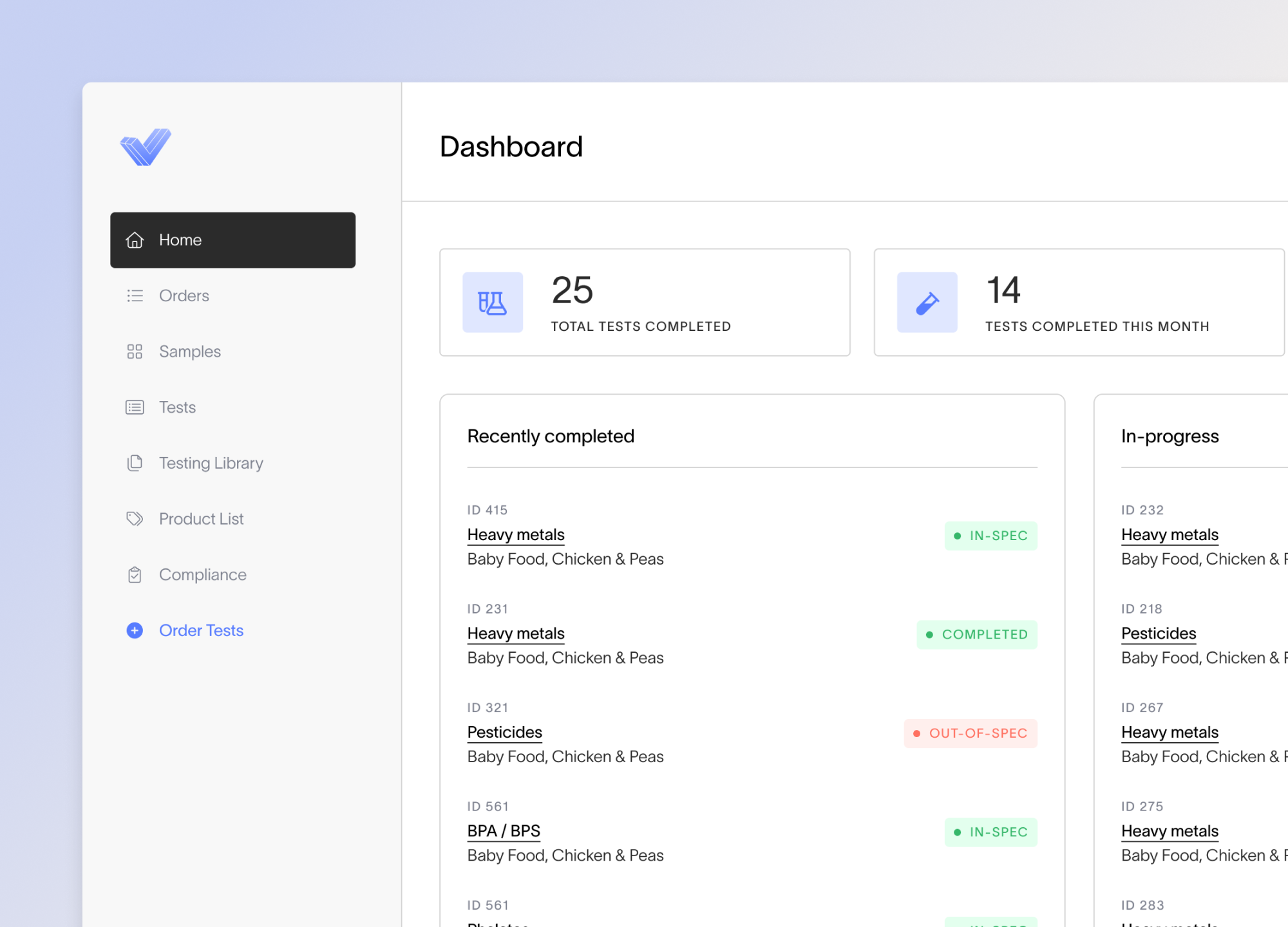
When a result needs investigation, our scientists can help you preserve the original record and plan the next test instead of losing time to email chains. Start a testing order with Light Labs.
Final takeaway
An OOS result is a signal to investigate, not a prompt to rerun until the number passes. Hold the material, preserve the original evidence, prove any laboratory cause, expand to the process and related lots when needed, and let quality control make a documented disposition. A complete record protects consumers, supports compliance, and turns an unexpected result into a better testing system.
Sources6 sources
- FDA Guidance for Industry: Investigating Out-of-Specification (OOS) Test Results for Pharmaceutical Production - U.S. Food and Drug Administration
- 21 CFR 211.192 - Production record review - Electronic Code of Federal Regulations
- 21 CFR 111.75 - What must you do to determine whether specifications are met? - Electronic Code of Federal Regulations
- 21 CFR 111.113 - What requirements apply to the quality control operations for dietary supplements? - Electronic Code of Federal Regulations
- 21 CFR 117.150 - Establishment and implementation of corrective action procedures - Cornell Legal Information Institute
- The New ISO/IEC 17025:2017 - International Accreditation Service
Whether you’re a brand or a co-manufacturer, Light Labs helps you move faster, stay compliant, and eliminate testing bottlenecks — all from a modern, shared platform.