
GLP vs GMP: Which quality system applies to your work?
GLP and GMP are both quality frameworks, but they protect different decisions. Good Laboratory Practice (GLP) protects the integrity of a defined nonclinical study. Good Manufacturing Practice (GMP, often written cGMP in U.S. rules) controls how regulated products are made, tested, and released. For food and supplement brands, a third-party contaminant test usually supports a GMP quality decision. It is not automatically a GLP study.
Food and supplement teams need to separate study data, lab results, and release decisions. Light Labs supports that work with an ISO/IEC 17025-accredited lab and software connecting results, COAs, specifications, and compliance reporting.
The short answer
Use the purpose of the work to choose the framework:
- A nonclinical safety study intended for a regulatory submission: GLP.
- Manufacturing, packaging, holding, or releasing a regulated product: GMP or cGMP under the product-specific rule.
- A food or supplement contaminant, identity, potency, or nutrition test: an appropriately scoped testing laboratory, often ISO/IEC 17025-accredited, supporting the manufacturer's GMP quality system.
- Research involving human participants: Good Clinical Practice (GCP). The product used in that research still needs the applicable GMP controls.
| Dimension | GLP | GMP or cGMP |
|---|---|---|
| The question it answers | Can a regulator reconstruct and trust this nonclinical study? | Was this product made, tested, and released according to approved requirements? |
| Primary object | A study, protocol, test article, raw data, report, and archive | A manufacturing system, process, material, batch, package, label, and release decision |
| Where it sits in the lifecycle | Nonclinical or preclinical safety work | Manufacturing, quality control, packaging, holding, and release |
| Accountable roles | Study director and an independent quality assurance unit | Production and quality-control personnel, with the manufacturer's quality unit responsible for disposition |
| Core records | Protocol and amendments, raw data, QA inspections, final report, specimens, and archives | Master and batch records, specifications, test results, deviations, investigations, stability, and release records |
| Common U.S. rules | FDA 21 CFR Part 58 and OECD GLP principles | FDA 21 CFR Parts 210 and 211 for many finished pharmaceuticals, Part 111 for dietary supplements, and Part 117 for human food |
Neither acronym is a universal quality badge. A claim is meaningful only when it identifies the activity, product category, jurisdiction, and records covered by the program. The examples use U.S. FDA rules; requirements in other markets can differ.
What GLP controls
Under 21 CFR Part 58, a nonclinical laboratory study is an in vivo or in vitro experiment in which a test article is studied prospectively in a test system under laboratory conditions to determine safety. The rule covers studies that support, or are intended to support, applications for research or marketing permits. It excludes studies involving human subjects, clinical studies, animal field trials, and basic exploratory work that only asks whether a test article might have utility or certain physical or chemical characteristics.
The OECD GLP principles describe GLP as a managerial system for planning, performing, monitoring, recording, reporting, and archiving nonclinical health and environmental safety studies. GLP is study-centered. Before work starts, the sponsor and testing facility define the protocol, test and control articles, test systems, methods, dates, and responsibilities.
The facility then needs:
- a named study director with overall responsibility for the technical conduct, interpretation, documentation, and reporting of the study
- a quality assurance unit that is independent of the people directing and conducting the study
- trained personnel, suitable facilities, maintained equipment, and written standard operating procedures
- controlled raw data, protocol changes, deviations, reports, specimens, and archives
A toxicology study on a new ingredient, a nonclinical pharmacokinetic study that supports a drug application, or a biocompatibility study for a medical device can be GLP work when it falls within the applicable regulatory purpose. The result is a defensible study record that another reviewer can reconstruct. A human pharmacokinetic study is clinical research, so it falls under Good Clinical Practice (GCP), not GLP.
GLP does not automatically apply to every analysis performed in a laboratory. A routine heavy-metals panel on a finished supplement is not a GLP study merely because it uses sophisticated equipment. It may support a manufacturer's cGMP quality program or be outsourced to an ISO/IEC 17025-accredited testing laboratory. A testing facility can conduct GLP studies and other work under different controls, so ask whether the specific study, facility, and records are covered.
What GMP controls
GMP starts with the product and the process that makes it. FDA's drug cGMP overview describes cGMP as the minimum requirements for the methods, facilities, and controls used to manufacture, process, and pack drug products. Those controls are intended to give each batch the identity, strength, quality, purity, and safety it is supposed to have. For many finished pharmaceuticals and later-stage drug supply, the central U.S. rules are 21 CFR Part 210 and 21 CFR Part 211. Do not treat that shorthand as an identical checklist for every investigational drug: under 21 CFR 210.2(c), most Phase 1 investigational drugs are subject to statutory cGMP requirements but are exempt from Part 211. FDA's Phase 1 guidance explains the phase-specific approach.
A GMP system asks what can affect the product and how the company will prevent, detect, investigate, and correct the problem. Typical evidence includes:
- an approved master production record and completed batch production record
- incoming-material checks, in-process monitoring, and finished-product testing
- qualified equipment, validated or verified methods, and calibration records
- sanitation, environmental, storage, and contamination-control records
- deviation investigations, corrective actions, and stability data
- quality-control review and a documented release, hold, or rejection decision
The exact rule depends on the product. Human-food facilities generally work under 21 CFR Part 117, which combines current good manufacturing practice with hazard analysis and risk-based preventive controls. Dietary supplements have additional requirements in 21 CFR Part 111. A drug, dietary supplement, conventional food, device, or chemical can therefore require a different GMP program and different records. Our food and supplement cGMP guide goes deeper on those product-specific controls.
The supplement example: a test result is one part of the GMP decision
Part 111 makes the distinction concrete for supplement teams. A manufacturer establishes specifications for identity, purity, strength, composition, and contamination limits, then uses appropriate, scientifically valid tests or examinations to determine whether those specifications are met. Quality-control personnel review the evidence and approve or reject the batch.
Before using a dietary ingredient, the manufacturer generally must conduct at least one appropriate identity test or examination unless FDA grants an exemption. For other components, the manufacturer may rely on a supplier COA only after qualifying the supplier, confirming the reliability of the supplier's results, retaining the method, limits, and actual results, and periodically reconfirming the supplier. The requirements are set out in 21 CFR 111.75.
A third-party laboratory may perform the analytical work used in a GMP release decision. That does not turn the laboratory into the product manufacturer or make the test report a GMP certificate. The manufacturer remains responsible for the specifications, sampling plan, investigation, and final disposition of the lot.
GMP quality-control responsibilities are not the same as the GLP quality assurance unit. Part 111 assigns quality-control personnel responsibility for reviewing tests, conducting material reviews, and approving or rejecting finished batches. Part 58 requires a GLP quality assurance unit that is separate and independent from the personnel directing and conducting the study. Both systems require documented oversight, but the roles, independence requirements, and decisions are different.
The differences that matter in practice
The quickest way to separate GLP from GMP is to identify the object being controlled:
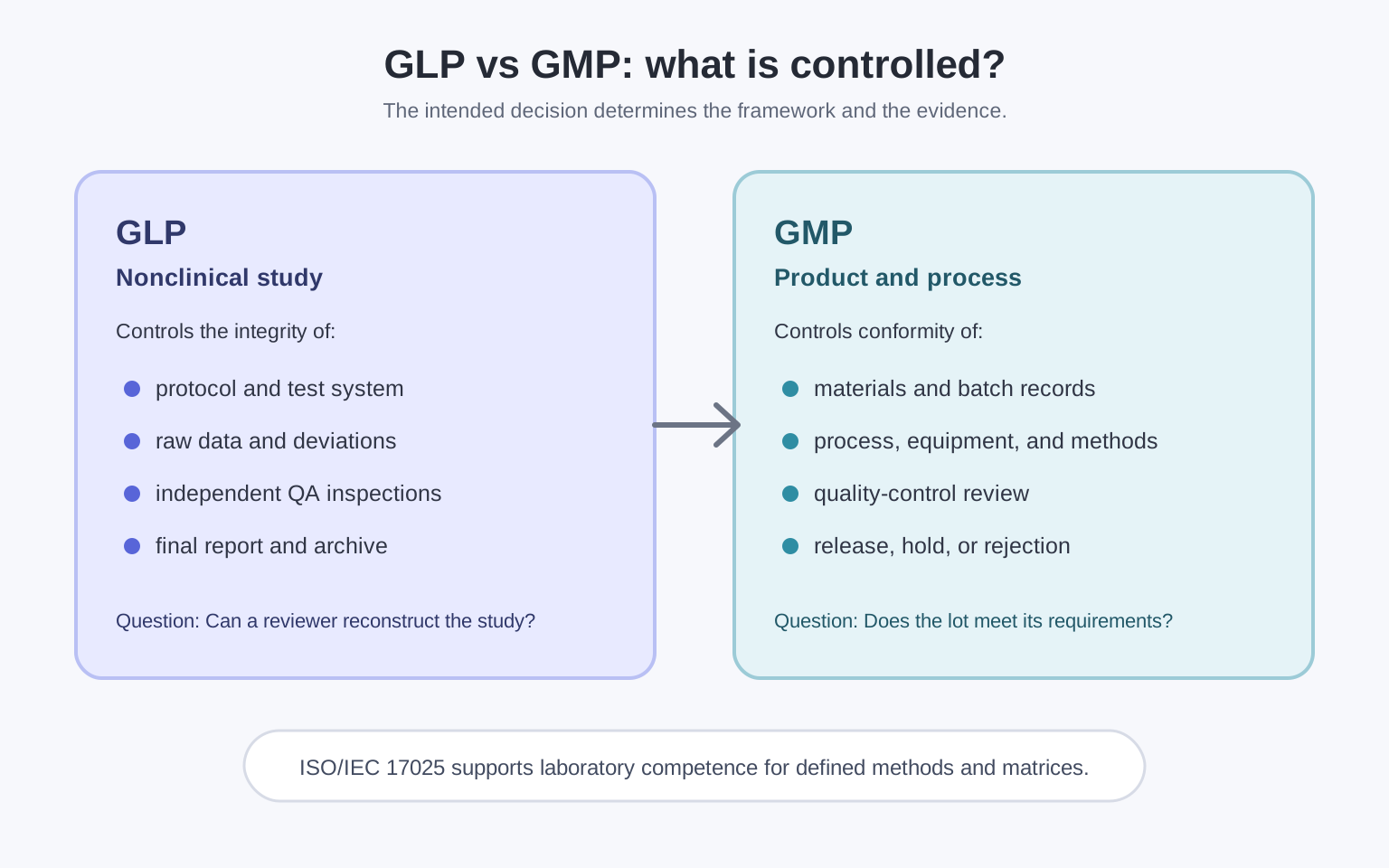
- GLP controls a study. The protocol, test system, raw data, QA inspections, final report, and archive must tell one coherent story about how the safety data was generated.
- GMP controls a product and its process. Materials, equipment, production steps, tests, deviations, packaging, labels, and release decisions must show that the batch meets its specifications.
- GLP ends in a study record. Its core question is whether the data is reliable and reconstructable for the intended regulatory use.
- GMP ends in a product decision. Its core question is whether the manufacturer can release the batch with documented confidence that it conforms to requirements.
The laboratory setting does not decide which system applies. A toxicology study in a laboratory can be GLP. A quality-control test in a laboratory can support GMP. The intended use and the decision that follows determine the framework.
Where GLP and GMP overlap
Both systems are built around controlled, traceable work. They commonly require:
- trained and qualified personnel
- suitable facilities and maintained, calibrated equipment
- written procedures and documented changes
- controls against mix-ups, contamination, and data loss
- defined quality oversight, with different independence and disposition requirements
- records that allow a reviewer to reconstruct what happened
The overlap is why the terms are easy to mix up. The purpose and unit of control remain different. GLP protects the integrity of a defined study and its data. GMP controls a repeatable production system and protects the conformity of its products and batches.
A GLP-compliant study does not show that a manufacturing line, supplier, or finished batch meets GMP. A GMP-controlled batch does not show that a nonclinical safety study followed GLP. A company developing a drug may need both, with GLP for nonclinical studies and applicable cGMP controls for clinical-trial and commercial supply. Human studies add the GCP framework for the ethical and scientific conduct of research involving people.
Where ISO/IEC 17025 fits
ISO/IEC 17025 is an international standard for the competence, impartiality, and consistent operation of testing and calibration laboratories. Accreditation is granted for a defined scope of methods, analytes, and matrices. It is not the same as GLP, GMP, or product certification.
That distinction matters for food and supplement brands, contract manufacturers, and quality teams. An ISO/IEC 17025-accredited laboratory can provide testing results for a contaminant, potency, identity, or nutrition test within its accredited scope. The result can support a COA, supplier qualification, a specification review, a customer request, or a lot-release decision. The brand or manufacturer still needs the applicable GMP controls and a documented quality decision.
When selecting a laboratory, match the accreditation scope to the actual request. Confirm the method, analyte, matrix, and reporting units, then define the sample and lot traceability that the manufacturer needs. A laboratory's accreditation status alone does not tell you whether a particular result is suitable for your intended decision.
Which framework applies to your work?
Start with the intended use, then define the evidence and decision owner before work begins.
| Your situation | Primary framework | Evidence to define before work starts |
|---|---|---|
| Nonclinical toxicology, pharmacology, or biocompatibility study intended for a regulatory submission | GLP | Approved protocol, study director, QA unit, raw-data plan, final report, and archive requirements |
| Human clinical trial | GCP for the study; GMP for the investigational product | Clinical protocol and oversight, plus manufacturing, packaging, labeling, and release records for the product |
| Commercial or later-stage drug manufacturing or batch release | Drug cGMP under Parts 210 and 211 | Specifications, qualified or validated methods, batch records, deviations, laboratory records, and QC release decision |
| Phase 1 investigational drug manufacture | Statutory cGMP requirements and the applicable FDA Phase 1 approach; Part 211 may be exempt under 21 CFR 210.2(c) | Product and process controls, QC records, and phase-appropriate release criteria defined for the IND |
| Conventional food manufacturing | Part 117 cGMP and preventive controls | Hazard analysis, preventive controls, sanitation and process records, verification, and corrective actions |
| Dietary supplement manufacturing | Part 111 dietary-supplement cGMP | Component and finished-product specifications, identity testing, scientifically valid methods, batch records, and QC disposition |
| Third-party contaminant or potency testing for food or supplements | ISO/IEC 17025 scope plus the manufacturer's GMP program | Method and matrix on the accreditation scope, sample and lot traceability, result units and limits, and the person who makes the release decision |
| Early research or method screening | Fit-for-purpose development controls | Intended use, method status, sample identity, acceptance criteria, and a clear statement that the work is exploratory if it is not GLP or GMP |
The testing laboratory can own the test method and report. The manufacturer or quality unit owns a product disposition, the study director owns the technical conduct of a GLP study, and the sponsor defines how study data will be used. Put that ownership in the request instead of leaving it implicit.
How to prevent a GLP/GMP mix-up in a test request
Before sending a sample or signing a statement of work, specify:
- Product and jurisdiction. A drug, device, dietary supplement, conventional food, and chemical can fall under different rules, and requirements change by market.
- Intended use. Say whether the output supports exploratory development, a GLP nonclinical study, GMP release, stability, a supplier review, a customer COA, or a marketing claim.
- Sample identity and chain of custody. Record the test article or lot number, matrix, collection date, storage conditions, and who handled the sample.
- Method and acceptance criteria. Identify the method, validation or verification status, reporting units, detection limits, specification or action limit, and what happens when a result is out of specification. For outsourced testing, identify whether the method and matrix are within the laboratory's ISO/IEC 17025 scope.
- Required quality records. A GLP study may need a protocol, QA statement, raw data, and archive. A release test may need a COA, batch link, deviation review, and QC approval.
- Decision owner. Name the study director, quality unit, manufacturer, or other person who can approve, hold, reject, investigate, or retest the work.
Asking a vendor only, “Can you do GLP or GMP testing?” is too vague. The useful question is whether the vendor can produce the specific evidence your intended decision requires.
FAQ
Is GLP the same as GMP?
No. GLP governs the conduct and records of defined nonclinical studies. GMP governs how regulated products are manufactured, tested, packaged, held, and released.
Which is stricter, GLP or GMP?
Neither is universally stricter. They control different risks. GLP is strict about protocol adherence, independent quality assurance, raw data, reporting, and archiving. GMP is strict about process control, contamination prevention, batch documentation, investigations, and product release.
Does ISO/IEC 17025 replace GLP or GMP?
No. ISO/IEC 17025 demonstrates laboratory competence for an accredited scope. It does not make a nonclinical study GLP-compliant or a manufacturing operation GMP-compliant.
Is a COA proof that a product is GMP-compliant?
No. A COA reports selected test results for a sample or lot. GMP compliance also depends on the manufacturer's facilities, process controls, specifications, records, investigations, and quality-control disposition. A COA can support a GMP decision when the test, method, sample, and acceptance criteria are appropriate.
Do dietary supplements need GLP testing?
Routine supplement identity, potency, purity, and contaminant testing normally supports the manufacturer's Part 111 cGMP specifications and quality-control release process. GLP applies when the work is a covered nonclinical safety study intended to support a regulatory submission.
Does a quality-control release lab need GLP?
Routine release testing is generally GMP-related work, even when it happens in a laboratory. The laboratory should use a suitable method and, when outsourced, an accreditation scope that covers the method and matrix. GLP is relevant when the work is part of a covered nonclinical study.
Is a human pharmacokinetic study GLP?
No. A human pharmacokinetic study is clinical research governed by GCP and the applicable clinical-trial requirements. A nonclinical pharmacokinetic study using an animal or another test system can be GLP when it is intended to support a regulatory submission. The investigational product used in a human study is manufactured under applicable cGMP controls, with phase-specific rules for many Phase 1 products.
Can one company use GLP and GMP at the same time?
Yes. A drug developer may run nonclinical studies under GLP while producing clinical or commercial batches under GMP. The company must keep the studies, manufacturing records, responsibilities, and claims about each system separate.
Build a testing workflow that matches the decision
Light Labs supports the analytical layer that food and supplement teams need for GMP decisions. Our ISO/IEC 17025-accredited lab offers testing for heavy metals, pesticides, microbes, microplastics, active ingredients, nutrition, and other product-specific needs. Our testing menu and platform connect orders and results with lots, specifications, COAs, action limits, retest notifications, and reporting.
That is different from a GLP preclinical study and different from a manufacturer's own cGMP system. It gives quality teams a traceable analytical record to use in supplier, label, or lot-release decisions. Our compliance workflow helps teams keep testing data and requirements organized in one place. If you need a testing and compliance workflow matched to the decision your team owns, request a demo.
Final takeaway
GLP protects the integrity of a defined nonclinical study. GMP protects the consistency and conformity of products made for use or sale. ISO/IEC 17025 shows that a testing laboratory is competent for specific methods and matrices; it does not replace either quality system. State the intended use before work begins, choose the rule that governs that decision, and keep the study, test report, and release record connected to the right owner.
Sources10 sources
- FDA: Nonclinical Laboratories Inspected Under Good Laboratory Practices - U.S. Food and Drug Administration
- OECD Principles on Good Laboratory Practice - Organisation for Economic Co-operation and Development
- FDA: Current Good Manufacturing Practice (CGMP) Regulations - U.S. Food and Drug Administration
- FDA: Current Good Manufacturing Practice for Phase 1 Investigational Drugs - U.S. Food and Drug Administration
- 21 CFR Part 58: Good Laboratory Practice for Nonclinical Laboratory Studies - Electronic Code of Federal Regulations
- 21 CFR Part 111: Current Good Manufacturing Practice for Dietary Supplements - Electronic Code of Federal Regulations
- 21 CFR Part 117: Current Good Manufacturing Practice, Hazard Analysis, and Risk-Based Preventive Controls for Human Food - Electronic Code of Federal Regulations
- 21 CFR Part 210: Current Good Manufacturing Practice in Manufacturing, Processing, Packing, or Holding of Drugs - Electronic Code of Federal Regulations
- 21 CFR Part 211: Current Good Manufacturing Practice for Finished Pharmaceuticals - Electronic Code of Federal Regulations
- ISO/IEC 17025:2017 — General requirements for the competence of testing and calibration laboratories - International Organization for Standardization
Whether you’re a brand or a co-manufacturer, Light Labs helps you move faster, stay compliant, and eliminate testing bottlenecks — all from a modern, shared platform.