
FDA Food Code 2022: A Practical Guide for Food Businesses
Food safety at the point of sale is governed by a patchwork of state and local rules. The FDA Food Code is the common blueprint behind many of them, but it is often mistaken for federal law or for the rules that govern a manufacturing plant. That distinction affects permits, procedures, training, records, and the evidence a brand gives its retail partners.
What the FDA Food Code is, and what it is not
The U.S. Food and Drug Administration publishes the Food Code as a model for safe food handling in retail and foodservice. It gives regulators a science-based template for restaurants, grocery stores, delis, bakeries, schools, hospitals, nursing homes, vending operations, and mobile food units. The FDA’s Food Code overview explains its purpose and lists every published edition.
The model does not automatically become a federal requirement. A state, county, city, tribal authority, or territory adopts an edition through its own law or regulation, often with additions and omissions. For a retail operation, an inspector enforces the text adopted in that jurisdiction; the FDA PDF remains the model reference. Two locations in the same region can therefore operate under different editions or different amendments.
The reason for the model is consistency. The Centers for Disease Control and Prevention estimates that 48 million people in the United States get sick from foodborne illness each year, with 128,000 hospitalizations and 3,000 deaths. A shared set of preventive controls gives local programs a common technical starting point while leaving enforcement with local government. CDC food-safety facts.
Which edition applies now
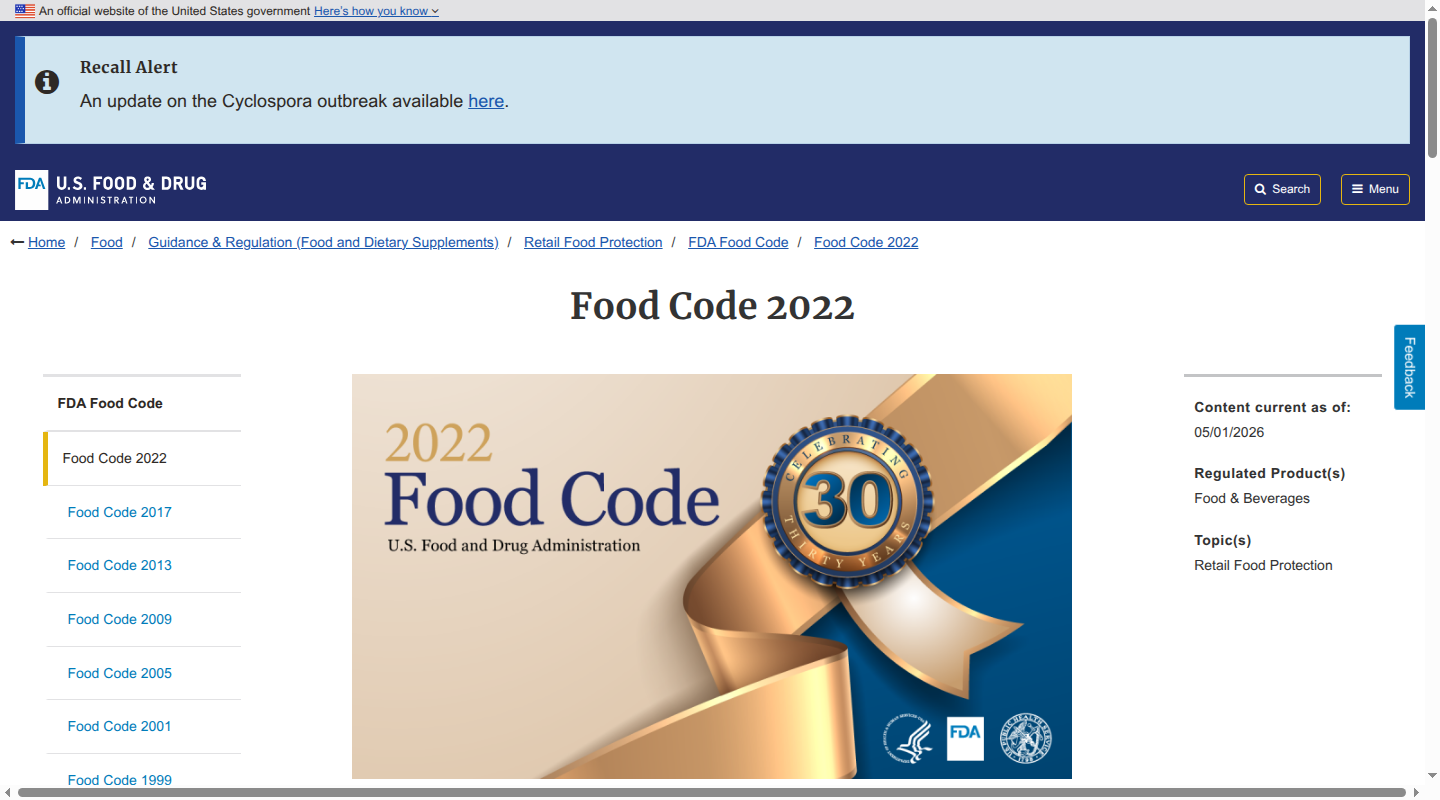
The latest full edition published by FDA is the 2022 Food Code, the 10th edition. Its version date is January 18, 2023. FDA issued a Supplement to the 2022 Food Code in November 2024 to incorporate recommendations from the 2023 Conference for Food Protection. The supplement is a model amendment, so it has legal effect only after an adopting authority incorporates it.
FDA’s 2026 priority plan says the agency will release an updated Food Code in 2026. Until a new edition is published and adopted, the 2022 edition and the 2024 supplement are the current federal model to use when building a program. The 2022 Food Code page provides the full document, print version, and change summary; you can also download the full 2022 Food Code PDF. The 2024 supplement explains the interim updates.
FDA’s 2024 adoption report shows why version control matters: 11 state agencies in seven states had adopted the 2022 version, covering 16.06% of the U.S. population. Thirty agencies in 24 states had adopted either 2022 or 2017, and 46 agencies in 36 states had adopted one of the three most recent editions. The state-by-state directory links each state’s retail and foodservice code.
Who falls under the Food Code?
Start with the activity and the buyer, rather than the product name. The same kitchen can contain a retail operation covered by the Food Code and a processing operation covered by federal manufacturing rules.
| Operation | How the Food Code fits | Main companion requirements |
|---|---|---|
| Restaurant, café, deli, bakery, or catering kitchen | Local health authority applies its adopted retail or foodservice code. | Permits, inspections, employee health, and food-manager rules. |
| Grocery or convenience store | Applies to food prepared, held, or sold in the retail operation. | Federal packaged-food labels plus state or local rules. |
| School, childcare, hospital, nursing-home, or correctional kitchen | Applies through institutional food rules, with added protections for highly susceptible populations. | Program-specific meal and procurement rules. |
| Vending machine, food truck, temporary event, or farmers-market kitchen | Applies when the jurisdiction regulates the unit as a retail food establishment. | Mobile-unit, water, waste, and event permits. |
| Factory or co-manufacturer making packaged food for other businesses | Usually a food processing plant, outside the Food Code’s retail scope. | FDA CGMP and preventive controls under 21 CFR part 117; supplements have separate part 111 rules. |
| Retail business that also manufactures food | Direct-to-consumer work can be retail; wholesale production can be a food processing plant. | Each activity, and shared equipment or utilities, can have requirements. |
FDA’s retail-establishment exemption flowchart defines a retail food establishment by its primary function: selling food directly to consumers. A business-to-business sale does not count as a consumer sale. FDA’s preventive-controls rule covers registered facilities that manufacture, process, pack, or hold human food, unless an exemption applies.
The boundary matters for brands. The Food Code does not replace a manufacturing food-safety plan, and a certificate of analysis does not replace retail controls such as handwashing, cold holding, or allergen communication. A brand can need both systems when it runs retail preparation alongside wholesale production.
How the code is organized
The chapter titles are stable across editions, while the detailed language and section numbers can change.
| Chapter or annex | What it covers |
|---|---|
| Chapter 1, Purpose and Definitions | Scope, defined terms, and risk categories such as time/temperature control for safety (TCS) food. |
| Chapter 2, Management and Personnel | Person in charge, employee health, handwashing, training, and hygiene. |
| Chapter 3, Food | Approved sources, protection from contamination, cooking, cooling, holding, reheating, date marking, allergens, and special processes. |
| Chapter 4, Equipment, Utensils, and Linens | Design, installation, cleaning, sanitizing, disinfection, and storage of equipment and utensils. |
| Chapter 5, Water, Plumbing, and Waste | Potable water, handwashing sinks, backflow, sewage, and refuse. |
| Chapter 6, Physical Facilities | Floors, walls, ceilings, lighting, ventilation, toilet rooms, and pest prevention. |
| Chapter 7, Poisonous or Toxic Materials | Identification, storage, and use of cleaners, sanitizers, pesticides, and other chemicals. |
| Chapter 8, Compliance and Enforcement | Permits, plan review, variances, HACCP plans, inspections, and corrective action. |
| Annexes | Public-health reasons, references, HACCP guidance, risk-based inspection tools, food-processing criteria, and model forms. |
Requirements carry one of three risk designations. Priority (P) provisions directly control a foodborne-illness hazard, such as cooking or handwashing. Priority foundation (Pf) provisions provide the people, equipment, records, or procedures needed to control that hazard. Unmarked provisions are core sanitation and maintenance requirements. A P or Pf mark helps a team decide what to correct first and what evidence an inspector may request.
FDA’s Decoding the Food Code training explains the numbering, cross-references, defined terms, and risk designations in more detail.
Core controls operators have to run
The following are the 2022 model’s practical baselines. An adopted local code can be more restrictive or use a different edition.
Temperature and time controls
TCS food supports pathogen growth when it remains in the 41°F to 135°F range for too long. The code controls that risk with measurable limits:
| Control | 2022 Food Code baseline | What to document |
|---|---|---|
| Cold holding | Keep TCS food at 41°F (5°C) or below. | Product or equipment temperatures and corrective actions. |
| Hot holding | Keep TCS food at 135°F (57°C) or above. Properly cooked roasts have a limited 130°F exception. | Line checks and calibrated thermometer readings. |
| Cooking | Typical limits are 145°F for 15 seconds for fish and intact meat, 155°F for 17 seconds for ground or nonintact meat and eggs not for immediate service, and 165°F for poultry, stuffed foods, and microwave cooking. | Product, time, equipment, and reader. |
| Cooling | Cool cooked TCS food from 135°F to 70°F within two hours, then to 41°F or below within six hours total. Food made from ambient ingredients must reach 41°F within four hours. | Start/end times, temperatures, batch, and method. |
| Reheating for hot holding | Reheat most cooked, cooled TCS food to 165°F for 15 seconds within two hours. Microwave food also needs stirring or rotation, covering, and a two-minute covered stand. Commercially processed, packaged ready-to-eat TCS food can reach 135°F. | Reheat temperature, time, method, and correction. |
| Date marking | Mark refrigerated, ready-to-eat TCS food held more than 24 hours and use or discard it within seven days, counting prep or opening as day one. | A system that identifies the discard day. |
The FDA’s date-marking fact sheet confirms that the code allows calendar dates, weekdays, color codes, or another system that identifies the discard day. It does not prescribe a particular sticker or require the preparation time on the label.
People, allergens, and sanitation
- Person in charge and employee health: A designated person in charge must oversee operations. Employees report symptoms and diagnoses that can transmit through food. The code requires food-allergen awareness training and controls bare-hand contact with ready-to-eat food.
- Allergen communication: The 2022 edition added sesame as the ninth major food allergen and requires written notification of major allergens in unpackaged food where that edition is adopted. Bulk food available for self-dispensing must identify the food sources of its major allergens. The FDA sesame update explains the retail provisions.
- Approved sources and contamination prevention: Food must come from lawful, approved sources and be protected from cross-contamination during receiving, storage, preparation, display, and transport. Molluscan shellfish identification, supplier records, and parasite-destruction records apply to relevant products.
- Facilities and equipment: Food-contact surfaces need to be cleanable and maintained. Handwashing sinks, potable water, plumbing, waste systems, chemical storage, and pest controls are part of the code because they support the process controls above.
- Special processes: Reduced-oxygen packaging, curing, smoking for preservation, sprouting, sushi rice acidification, and other higher-risk processes can require a HACCP plan, a variance, or both, depending on the process and the local authority.
What changed in 2022 and in the 2024 supplement
The most useful way to read the update is as a set of operational changes, not a list of renumbered paragraphs.
| Update | Operational effect |
|---|---|
| Sesame became the ninth major allergen (2022) | Packaged foods must declare sesame under federal allergen law, and retail operations adopting the 2022 code must provide written allergen information for relevant unpackaged and bulk foods. |
| Food donations were addressed (2022) | Food that is stored, prepared, packaged, displayed, and labeled under the code can be donated, subject to law and safe handling. |
| Handwashing-sink water minimum changed (2022) | The model specifies at least 85°F at a handwashing sink through a mixing valve or combination faucet. |
| Disinfection provisions (2024 supplement) | New Part 4-10 addresses disinfection of equipment and food-contact and nonfood-contact surfaces when available sanitizers do not control the pathogen of concern, including contamination by bodily fluids or an outbreak. |
| Food defense and active managerial control (2024 supplement) | New definitions and training expectations address intentional adulteration and require a written Food Safety Management System within four years of a jurisdiction’s adoption, except for operations the authority considers minimal risk. |
| Employee reinstatement testing (2024 supplement) | Validated culture-independent diagnostic tests from an accredited or certified laboratory can be used alongside other requirements when an employee returns after certain diagnosed illnesses. |
| Reusable containers and sushi rice (2024 supplement) | Refilling and reuse rules are clearer, and Annex 6 adds dedicated guidance for sushi-rice acidification controls. |
The FDA supplement release contains the complete list. A supplement is not self-executing law; it becomes enforceable through adoption by the relevant authority.
A practical workflow for brands and manufacturers
Use one compliance map for every place food is made, held, or sold:
- Classify each activity. Record whether the site serves consumers directly, supplies another business, or does both. Include co-manufacturers, fulfillment centers, retail kitchens, pop-ups, and online orders.
- Identify the adopted code. Link each retail site to its state or local code, edition, amendments, permit, and inspection contact. The FDA state directory is a useful index, but the local adopted text controls.
- Map requirements to owners and records. For each applicable section, assign an owner and define the SOP, training, log, corrective action, and retention period. Make the P and Pf controls visible in the daily workflow.
- Separate process evidence from product evidence. Temperature logs, cleaning records, allergen matrices, employee-health forms, HACCP plans, and variances demonstrate retail controls. Product testing, supplier certificates, and lot-level certificates of analysis address ingredient and finished-product hazards under the relevant manufacturing or quality program. Neither category substitutes for the other.
- Keep the handoff intact. Assign who receives samples, approves lots, releases product, and responds to out-of-spec results. A SKU can have manufacturing, retail-preparation, and customer-facing records.
At Light Labs, our ISO 17025-accredited lab tests food and supplement products for contaminants and other quality attributes. Our testing platform keeps results, action limits, retest notifications, and COA exports in one workspace. That evidence helps a quality team manage supplier and product decisions; it does not replace a retail kitchen’s Food Code procedures or permit.
FAQ
Is the FDA Food Code federal law?
No. It is a model published by FDA. A state, local, tribal, territorial, or federal authority must adopt it before the provisions are enforceable there.
What is the latest FDA Food Code?
The latest full edition published by FDA is the 2022 Food Code, dated January 18, 2023. FDA issued a supplement in November 2024 and lists an updated edition as a 2026 priority deliverable. The local adopted code controls.
Does the FDA Food Code apply to a food manufacturer?
Usually not when a plant makes packaged food for other businesses. Those facilities generally operate under FDA CGMP and FSMA preventive-control requirements, or other commodity-specific rules. A direct-to-consumer retail operation can have both frameworks.
What is the FDA Food Code temperature danger zone?
The model identifies 41°F to 135°F as the range in which TCS food can support rapid pathogen growth. Cold holding is 41°F or below and hot holding is 135°F or above, subject to specific exceptions.
Does a passing laboratory result prove Food Code compliance?
No. A laboratory result speaks to the sample and analytes tested. Food Code compliance also depends on people, equipment, sanitation, time and temperature controls, records, and local permit conditions.
How we help brands connect testing to compliance
Retail partners and internal quality teams need a reliable record of what was tested, which limit applied, and what happened when a result was out of spec. We bring those details together across finished goods, raw materials, SKUs, and co-manufacturers, with fast turnaround and audit-ready exports. The result is a clearer link between product data and the decisions a Food Code or FSMA program requires.
The practical takeaway
Treat the FDA Food Code as the retail and foodservice blueprint, then anchor your program to the version your jurisdiction adopted. Keep retail operating controls separate from manufacturing preventive controls, and connect both to lot-level evidence and clear ownership. When you need a single place to run the testing side of that system, start your workflow with Light Labs.
Sources13 sources
- FDA Food Code overview - U.S. Food and Drug Administration
- CDC food-safety facts - Centers for Disease Control and Prevention
- Human Foods Program 2026 priority deliverables - U.S. Food and Drug Administration
- Food Code 2022 - U.S. Food and Drug Administration
- FDA Food Code 2022 full document - U.S. Food and Drug Administration
- FDA releases supplement to the 2022 Food Code - U.S. Food and Drug Administration
- 2024 FDA Food Code adoption report - U.S. Food and Drug Administration
- State retail and food service codes and regulations - U.S. Food and Drug Administration
- Retail Food Establishment Exemption Flowchart - U.S. Food and Drug Administration
- FSMA final rule for preventive controls for human food - U.S. Food and Drug Administration
- Decoding the Food Code training - U.S. Food and Drug Administration
- Date-marking fact sheet - U.S. Food and Drug Administration
- Addition of sesame to the major food allergen list - U.S. Food and Drug Administration
Whether you’re a brand or a co-manufacturer, Light Labs helps you move faster, stay compliant, and eliminate testing bottlenecks — all from a modern, shared platform.