
FAT TOM food safety: the six conditions that let pathogens grow
A cooked meal can look fine and still support a dangerous increase in bacteria. Food handlers use FAT TOM as a quick way to spot the conditions that make that growth possible. The mnemonic is useful at home, in a restaurant, and in a manufacturing plant, as long as you use it to guide measurable controls rather than as a pass/fail test. Here is what each letter means, where the common temperature numbers come from, and how to apply the framework to real products.
What FAT TOM means
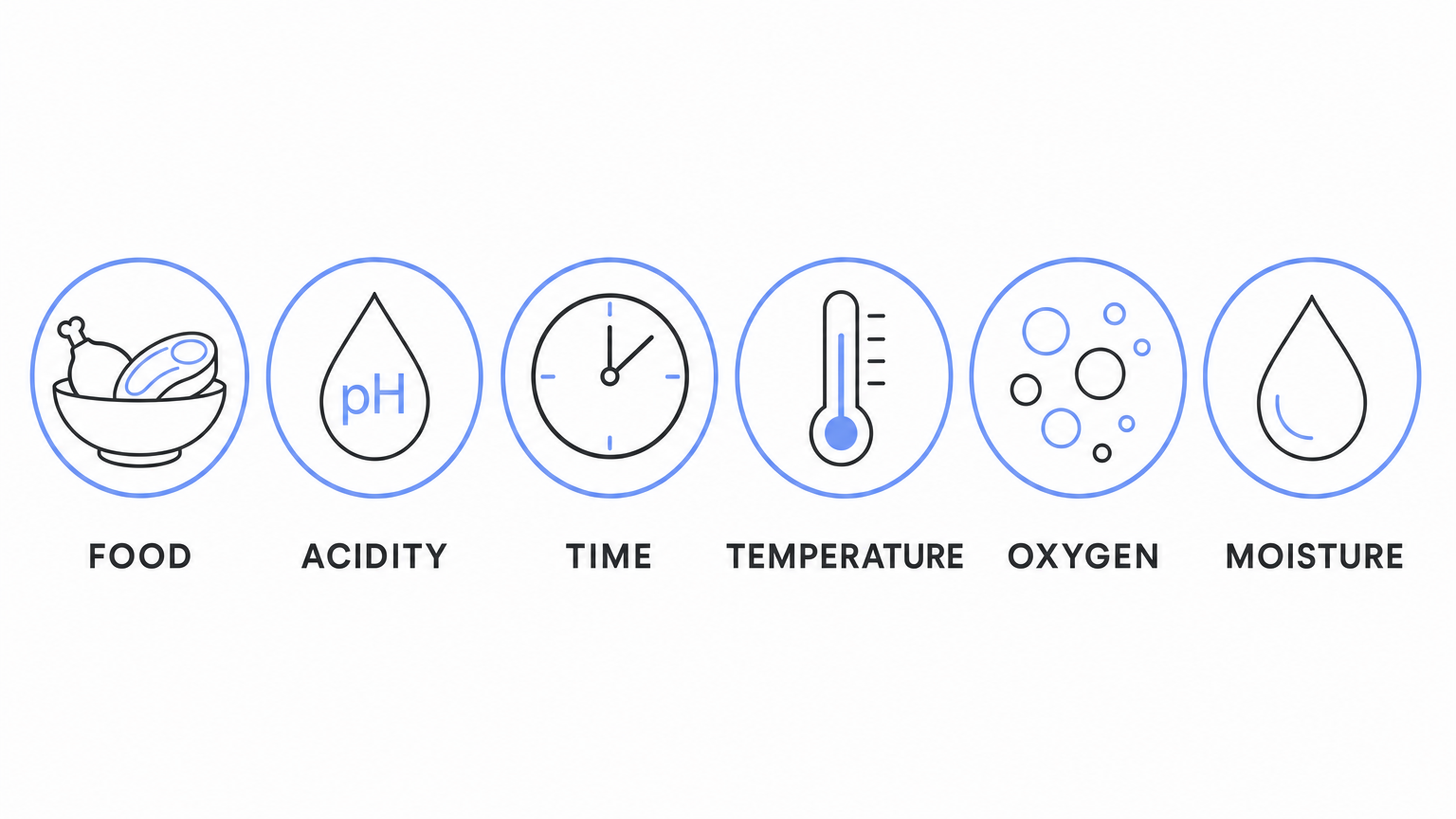
FAT TOM is a food-safety mnemonic for six conditions that support the growth of many foodborne microorganisms:
- F: Food: nutrients the organism can use
- A: Acidity: a suitable pH
- T: Time: enough time for cells to multiply
- T: Temperature: a growth-friendly temperature
- O: Oxygen: an atmosphere the organism can tolerate
- M: Moisture: available water, measured as water activity
The ServSafe glossary lists the same six conditions. You will also see FATTOM, with the two T's written as “temperature, time.” Courses sometimes reverse the T's to make the sentence read more naturally. The factors and the controls do not change.
“Fat” in the name does not mean dietary fat. A fatty food is not automatically unsafe, and a low-fat food is not automatically safe. The first letter means food, the nutrient source. What matters is the product's available nutrients and water, its pH, its temperature history, and the organism involved.
FAT TOM describes conditions for growth after contamination. It does not tell you whether a product is contaminated in the first place, and it does not cover every hazard. A virus such as norovirus can remain infectious without multiplying in food; FDA HACCP guidance points to sanitation, employee health and prevention of cross-contamination as the controls in that case. Bacterial spores and toxins can also survive a step that removes ordinary, growing cells.
The six conditions and how to control them
| Letter | Condition | What favors growth | Practical controls |
|---|---|---|---|
| F | Food | Nutrients such as proteins, sugars and starches. Moist meat, dairy, eggs, cooked rice, sauces and some cut produce are common time/temperature-control-for-safety (TCS) foods. | Buy from approved suppliers, prevent raw-to-ready-to-eat cross-contact, clean and sanitize equipment, and keep exposed product covered. |
| A | Acidity | Many bacterial pathogens grow best in low-acid to near-neutral foods. Lowering pH slows or stops particular organisms. | Use a validated acidification or fermentation process. Measure the finished, equilibrated product with a calibrated pH meter instead of relying on taste or a recipe's expected value. |
| T | Time | Each generation adds more cells. Under ideal conditions, some bacteria can double in about 20 minutes. | Start a time record at receiving or preparation, set discard limits, and shorten the time in the growth range during cooling, service and transport. |
| T | Temperature | Growth is fastest in the temperature danger zone. USDA consumer guidance uses 40–140°F (4–60°C); the FDA Food Code uses 41–135°F (5–57°C) for TCS controls. | Use a calibrated probe thermometer, keep cold food at or below the limit in your code and hot food at or above its hot-holding limit, and validate cooking and cooling steps. |
| O | Oxygen | Oxygen favors aerobic organisms, while reduced oxygen favors organisms that tolerate or require anaerobic conditions. | Treat vacuum or modified-atmosphere packaging as a process control that needs validation. Pair it with refrigeration, pH, water activity or a lethality step when the hazard analysis calls for it. |
| M | Moisture | Microbes need available water. Water activity (a_w) captures that availability; total moisture percentage does not. | Dry the product or bind water with salt, sugar or another validated formulation. Measure a_w in the finished product and after meaningful formulation or packaging changes. |
For food and supplement brands, each row can become a measurable product specification. Our ISO 17025-accredited lab measures microbial load, pH and moisture so teams can verify those controls against a documented plan.
Food: the nutrient source
Bacteria need a usable source of carbon, nitrogen and minerals. Raw ingredients can carry organisms, while cooking can make nutrients easier to access. Cooked rice and pasta, for example, become moist, nutrient-rich foods that need quick cooling and cold holding. Keeping a clean ingredient and equipment flow reduces the starting load, yet it cannot replace time and temperature control.
Acidity: pH is a control, not a promise
A pH reading describes acidity at the moment and location of measurement. A chunky sauce can have acidic liquid around a higher-pH vegetable piece, so a single surface reading can be misleading. Measure a representative, blended sample at equilibrium and follow a validated method for the product.
For U.S. commercial acidified foods in hermetically sealed containers, FDA defines an acidified food as a low-acid food with a finished equilibrium pH of 4.6 or below and water activity above 0.85. The FDA acidified-food guidance also requires U.S. processors to register and file scheduled processes. A pH number alone is not a shelf-stability study. Acid, heat, water activity and package integrity must work together.
Time and temperature: the controls most people can change today
USDA reports that bacteria can double in as little as 20 minutes in the 40–140°F danger zone. Its consumer rule is to refrigerate perishables within two hours, or within one hour when the surrounding temperature is above 90°F. CDC storage guidance gives the same limits and recommends a refrigerator at 40°F or below.
Commercial kitchens use the FDA Food Code's tighter TCS range and cooling schedule. Cooked TCS food must cool from 135°F to 70°F within two hours, then reach 41°F or below within a total of six hours. Shallow pans, smaller portions, an ice bath and containers that transfer heat quickly help meet the limits. Record the actual product temperature, not only the refrigerator's set point. Your state or local authority may adopt a different code, so the applicable jurisdiction controls.
Heating is a lethality step; holding is a growth-control step. Reheating food that has already allowed toxin production may not make it safe. For example, FDA's B. cereus manual notes that spores can survive cooking and multiply in rice held warm for several hours, and some toxins are heat-stable. Follow the validated cook, cool, hold and reheat process as a sequence.
Oxygen: why a vacuum can create a new hazard
Removing air slows many aerobic spoilage organisms. It does not sterilize a product. A low-oxygen package can support Clostridium botulinum if the food is moist, low in acid and held under favorable temperatures, as described in FDA's botulism manual. Fresh garlic submerged in oil is a classic example: the oil creates low oxygen while the garlic supplies moisture and nutrients. Use a tested formulation and process, and keep products refrigerated when refrigeration is the safety barrier. Never treat a home vacuum sealer as a substitute for a validated canning or acidification process.
Moisture: measure water activity, not just water content
Water activity is the fraction of water available for microbial use. Salt, sugar and drying can lower it even when a product still contains water; freezing controls growth primarily through temperature. The FDA water-activity guide notes that most foods have an a_w above 0.95, which supports bacteria, yeasts and molds, and uses 0.85 or below as a regulatory boundary for certain canned-food rules.
A moisture percentage cannot substitute for an a_w result. Two products with the same moisture content can bind water differently and have different microbial behavior. Measure a_w on the finished matrix, at a controlled temperature, and set a specification that matches the organism and the product's other hurdles.
Why one FAT TOM factor rarely settles safety
The six factors interact. A food can sit outside a single “danger” range and still support a pathogen because another factor offsets it. FDA's Food Code calls this hurdle technology: combinations such as pH plus water activity, or heat plus an intact package, can control a hazard when one factor alone would not. The Code recommends product-specific scientific evidence or an inoculation (challenge) study for combination products and new technologies.
Consider three everyday examples:
- Cooked rice: nutrient-rich food, high available water, near-neutral pH, and a long warm hold give B. cereus an opportunity to grow. Rapid cooling and cold holding remove time and temperature; acidifying sushi rice is a separate, validated process.
- Fresh garlic in oil: low oxygen, high local moisture and low acidity create a potential C. botulinum hazard. Refrigeration, acidification and a validated process are the controls, not the oil itself.
- Acidified salsa: a tested formulation can lower equilibrium pH, and a scheduled heat process can destroy vegetative cells. The container still needs an intact seal, and the finished product needs verification after formulation changes.
Turning FAT TOM into a manufacturing control plan
For a food or supplement brand, use the mnemonic as a prompt during hazard analysis:
- Map the flow. Include receiving, storage, preparation, cooking or pasteurization, cooling, packaging, shipping and the consumer's expected use.
- Name the organism and hazard. Decide whether the concern is growth, toxin formation, survival through a process, or post-process contamination. FAT TOM is most useful when it is tied to a specific organism and matrix.
- Choose measurable critical limits. Examples include a pH range, a_w maximum, a time-temperature curve, a validated heat reduction, or an oxygen/package specification.
- Monitor at the point of control. Calibrate thermometers and pH meters, log cooling temperatures, verify seals, and document ingredient or preservative additions.
- Verify independently. Review records, calibrate instruments, sample finished lots and use a challenge study when the product assessment requires one. The FDA HACCP guidance calls for validation of critical limits and verification that the plan operates as written.
- Act on a deviation. Hold the affected lot, assess the time and temperature history, investigate the cause, and document disposition. A clean result from one sample does not validate an uncontrolled process.
This approach turns FAT TOM from a memorization question into a practical design review. It also clarifies what to test. A total plate count can show overall aerobic load; targeted assays address pathogens such as Salmonella, Listeria monocytogenes or B. cereus; pH and a_w measurements confirm formulation hurdles.
FAT TOM FAQ
Is FAT TOM the same as FATTOM?
Yes. Both names describe Food, Acidity, Time, Temperature, Oxygen and Moisture. Training programs may place Temperature before Time, or Time before Temperature. Learn the version used by your course, then apply the same controls.
What is the food safety danger zone?
For consumer handling, USDA uses 40–140°F (4–60°C). The FDA Food Code uses 41–135°F (5–57°C) for TCS food controls in retail and food service. Follow the code adopted by your local authority and your validated process limits.
Can low pH make a product shelf-stable?
Not by itself. Shelf stability depends on the organism, equilibrium pH, water activity, heat process, package and intended storage. Commercial acidified products require a scheduled process, and products in a product-assessment category may need scientific challenge data.
Does FAT TOM apply to viruses or parasites?
It is mainly a bacterial-growth mnemonic. Human viruses and parasites do not multiply in food, so their controls focus on preventing contamination and using an effective inactivation step when one is available.
Which FAT TOM factors can a food handler control most easily?
Time and temperature are usually the quickest levers during a shift: use a clock, a calibrated thermometer and the right cooling equipment. Manufacturers can also control acidity, moisture and oxygen through formulation and packaging, provided those controls are validated and monitored.
How we help brands verify the controls
At Light Labs, our ISO 17025-accredited laboratory and software platform give food and supplement teams a place to verify those controls. Our microbial testing menu includes total plate count, yeast and mold, coliforms, Salmonella, Listeria monocytogenes, B. cereus and dedicated anaerobic counts, with many routine results in three to five days. Our stability testing includes pH and moisture measurements that support product specifications and shelf-life work. Results can be tied to internal limits and batches in one compliance workflow, so a deviation leads to an action rather than a spreadsheet chase.
Final takeaway
FAT TOM is a compact way to ask practical questions: Does the product provide food and moisture? Is the pH favorable? Has it spent too long at a growth-friendly temperature? Does the package change oxygen? The answers point to controls, measurements and verification. If you are building or tightening a microbial control plan, talk with Light Labs about the tests and workflow that fit your product.
Sources10 sources
- ServSafe glossary - ServSafe
- HACCP guidance - U.S. Food and Drug Administration
- Acidified and low-acid canned foods guidance - U.S. Food and Drug Administration
- Danger zone: 40°F to 140°F - USDA Food Safety and Inspection Service
- Food safety prevention - Centers for Disease Control and Prevention
- FDA Food Code 2022 - U.S. Food and Drug Administration
- BAM Chapter 14: Bacillus cereus - U.S. Food and Drug Administration
- Botulism manual - U.S. Food and Drug Administration
- Water activity guide - U.S. Food and Drug Administration
- HACCP principles and application guidelines - U.S. Food and Drug Administration
Whether you’re a brand or a co-manufacturer, Light Labs helps you move faster, stay compliant, and eliminate testing bottlenecks — all from a modern, shared platform.