
Expiration dates on products: what they mean and how brands set them
The date printed on a product can describe peak quality, a retailer’s stock rotation, a manufacturing batch, or the end of a validated shelf life. Treating every date as the same can lead to avoidable waste for shoppers and weak support for brands’ label decisions. We explain how to read the common labels, what changes by product category, and how food and supplement teams build a defensible date from stability data.
The examples use U.S. food, supplement, drug, and cosmetics frameworks. Imported products can use different date phrases and symbols.
The short answer: a date is a claim about a defined product
A date only has meaning alongside the product, package, storage conditions, and wording around it. A “Best if Used By” date on a sealed box of cereal is a quality target. A drug expiration date is the end of the period for which the manufacturer supports strength, quality, and purity under the labeled conditions. A lot code may identify when, where, or which batch was made. It is not an expiration date unless the manufacturer defines it that way.
Shelf life is the time a product is expected to stay within its approved specifications while unopened and stored as directed. Those specifications can cover safety, potency, nutrients, sensory quality, package integrity, or all of them. The printed date is the customer-facing expression of that decision, not a universal countdown for every home.
What the common date labels mean
U.S. food labels do not use one federally standardized vocabulary. This FDA and USDA date-labeling guidance and FDA consumer guidance describe the terms below as they are generally used. State rules and product-specific requirements can add exceptions.
| Label you may see | Usually tells you | What it does not tell you |
|---|---|---|
| Best if Used By or Best Before | When an unopened product should have its best flavor, texture, color, or other quality attributes | A universal safety deadline for packaged food |
| Use By | The manufacturer’s recommended last date for use at peak quality; the meaning depends on the product and applicable rules | That every product becomes unsafe at midnight on that date |
| Sell By | How long a store should display the product for inventory and quality management | How long the product will last in a consumer’s home |
| Freeze By | When to freeze a product to preserve peak quality | A guarantee that freezing repairs previous temperature abuse |
| Expires On or Expiration | A date the manufacturer has defined for a specific category; on food, the phrase has no single federal definition | That the same wording means the same thing across foods, supplements, medicines, and cosmetics |
| Packed On, Manufactured On, or a lot code | When or where a batch was produced, packed, or coded for traceability | The product’s validated shelf life unless the maker says the code is an expiration date |
A date can also be paired with an opening instruction, such as “use within 30 days of opening.” Once a package is opened, air, moisture, utensils, and handling can change the product’s stability. The unopened-package date should not be used as the only control after opening.
The one distinction shoppers should remember
Most packaged-food date labels in the United States describe quality. The FDA says that, with the exception of infant formula, federal law does not require manufacturers to put a quality-based date on packaged food. A “Best if Used By” date can pass while a properly stored product remains acceptable in quality, although quality can decline. Food that was mishandled can become unsafe before the printed date, and some hazards leave no obvious smell or visual sign. Storage instructions and the product’s risk profile still matter.
How the meaning changes by product category
Food and beverages
For most food sold in the U.S., date marking is voluntary and the terminology is not uniform. FDA and USDA support “Best if Used By” as a clear quality phrase. Meat, poultry, and egg products under USDA jurisdiction can carry voluntary dates when the wording is truthful and not misleading. Infant formula is the important federal exception: its use-by date must be followed because nutrient levels can decline.
For shoppers, ask whether the product stayed within its required temperature range, whether the package is intact, and whether the label describes quality or use after opening. For brands, the date should come from product-specific evidence rather than a generic rule such as “all bars last 12 months.”
Dietary supplements
The FDA does not require an expiration date on a dietary supplement. If a manufacturer chooses to print an expiration, shelf, or “best if used by” date, the date must be supported by valid data so the label is not false or misleading. The FDA supplement labeling guide explains that distinction.
A supplement date normally applies to the unopened container stored under the labeled conditions. The evidence may need to show that active ingredients remain within specification, the product stays within microbiological and physical limits, and the package continues to protect it from moisture, oxygen, and light. A manufacture date alone does not demonstrate potency at the end of the claimed shelf life.
Drugs
Drugs use a stricter stability framework. FDA says a drug expiration date reflects the period in which the product is known to remain stable, retaining its strength, quality, and purity when stored as labeled. Applicants and manufacturers support the date with stability testing under FDA requirements.
Cosmetics and personal-care products
U.S. law does not generally require cosmetic manufacturers to print an expiration date. The manufacturer remains responsible for ensuring the product is safe, including determining a reasonable shelf life. Products such as sunscreen and acne treatments may be regulated as drugs, while products such as SPF moisturizers may be regulated as both cosmetics and drugs, so their applicable drug stability and expiration requirements can differ. FDA’s cosmetics shelf-life guidance explains why formula, packaging, use, and storage all affect that decision.
FAQ
Are expiration dates required on all food products?
No. In the United States, federal law generally does not require a quality date on packaged food. Infant formula is the main federal exception. State requirements and category-specific rules can differ, so brands should map the label to the markets and products they sell.
Is food safe after a ‘Best if Used By’ date?
That phrase generally communicates peak quality, not a universal safety deadline. Safety still depends on formulation, packaging, temperature control, handling, and the presence of hazards that may not create visible spoilage. Follow the storage and use instructions, and do not use a product with a damaged package or clear signs of spoilage.
Do dietary supplements have to show an expiration date?
No. A supplement maker can omit the date, but any expiration, shelf, or ‘best if used by’ date it prints needs valid supporting data so the label is not misleading. The claim normally applies to the unopened product under the stated storage conditions.
How is an expiration date different from a manufacture date?
A manufacture or pack date identifies when a product was made or packed. An expiration or best-by date communicates how long the manufacturer expects the product to meet a defined quality or stability target. A lot code may contain a date, but you should not interpret it without the manufacturer’s coding key.
How long does shelf-life testing take?
Real-time testing takes as long as the proposed shelf life, because samples must be observed through that period. Accelerated studies can provide earlier signals about degradation and help compare options, but they need appropriate validation and real-time follow-up before a long claim is treated as established.
Where Light Labs fits in the date-setting workflow
Light Labs helps food and supplement teams generate and manage the analytical evidence behind product-quality decisions. Our ISO 17025-accredited lab lists 24 stability assays, including moisture, pH, peroxide value, acid value, sensory attributes, package closure checks, and headspace oxygen and carbon dioxide. We also run targeted microbiology, contaminant, nutrient, and active-ingredient testing when those attributes belong in the study.
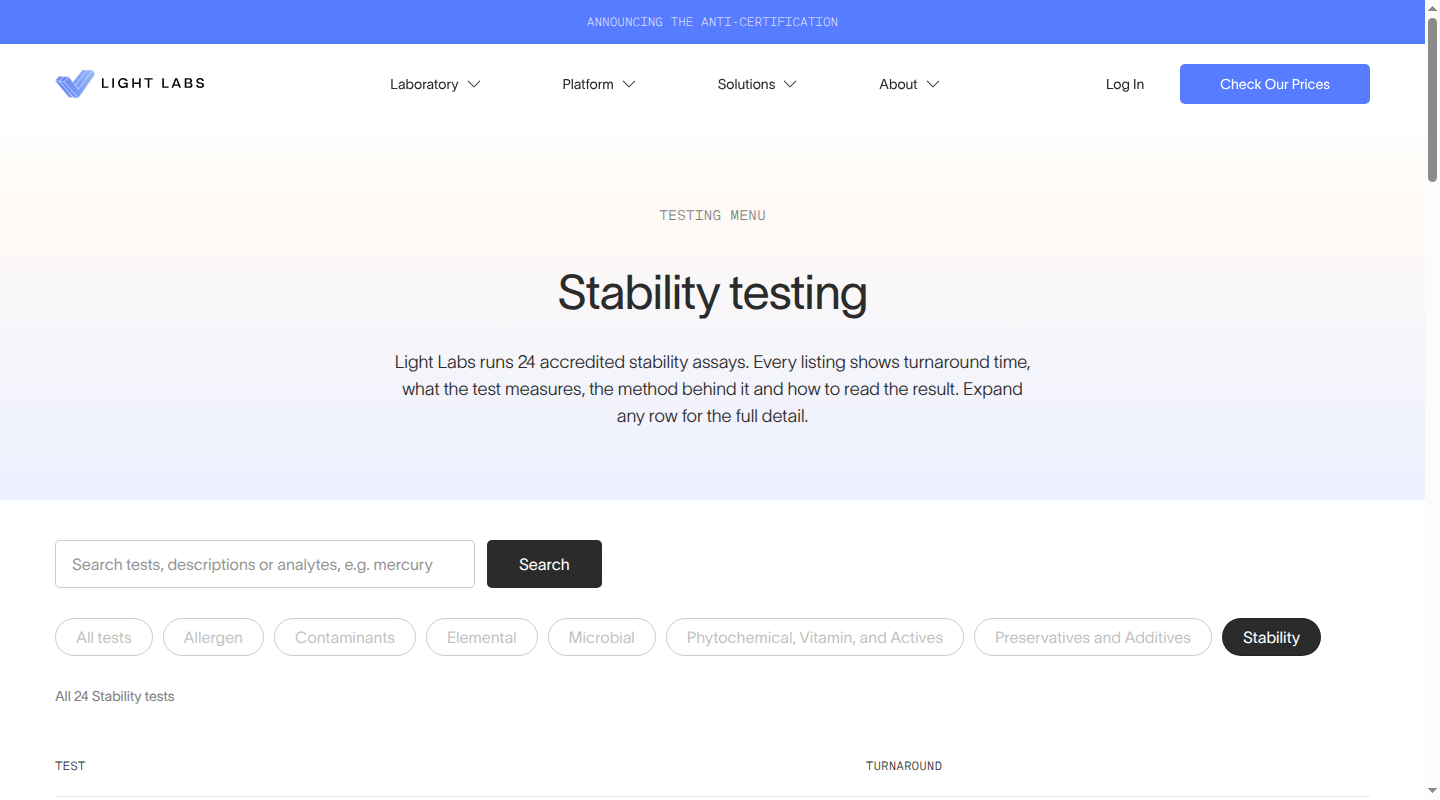
The workflow is specific: define the product’s specifications and storage protocol, submit representative samples, connect each result to the lot and time point, and review trends against the limits. Our stability testing menu shows the method, sample requirements, and turnaround for each assay. The final expiration date remains the brand’s quality and regulatory decision, supported by the complete stability record.
Our testing and compliance platform brings testing data and action limits into one workflow, giving teams a place to review trends before they affect a label or inventory decision.
How brands establish an expiration date
A credible date is the endpoint of a documented study, not a guess based on the oldest ingredient. A practical program follows this sequence.
1. Define the claim and the failure limits
Start by writing what “acceptable through the date” means for that product. Examples include:
- pathogen or spoilage-organism limits
- active-ingredient or nutrient potency
- moisture, water activity, pH, or acidity
- oxidation or rancidity markers
- flavor, odor, color, texture, and appearance
- package seal, closure, and label integrity
- contaminant limits that must remain in control
Set the storage statement at the same time. “Store in a cool, dry place” is difficult to study unless the team defines measurable temperature and humidity ranges. Decide whether the date covers the unopened package only and whether a separate after-opening instruction is needed.
2. Use representative production batches and final packaging
Test product made with the commercial formula, process, and packaging. A pilot batch in a temporary container can miss interactions between the product and its closure, liner, desiccant, film, or headspace. Include enough batches to show that the proposed date is not a one-lot result, and record the lot, manufacturing date, package configuration, and storage history.
3. Run real-time stability testing
Store samples under the labeled conditions and test them at planned intervals, including the proposed end date. The schedule should capture the period when a quality attribute is most likely to cross its limit. Real-time data are the most direct evidence for the product’s actual storage claim.
4. Use accelerated testing as an early signal
Higher temperature or humidity can reveal likely degradation pathways sooner. Accelerated studies help compare formulas, packages, and antioxidants and can support a provisional shelf-life decision when paired with a plan for real-time follow-up. They are not a shortcut for ignoring real-world storage. A reaction that appears at an elevated temperature can follow a different mechanism than the one that limits the product at room temperature.
5. Test the attributes that can actually fail
A shelf-life panel should follow the product’s risk profile. Common examples include:
- Moisture and water activity: identify water available for microbial growth, caking, texture change, and chemical reactions.
- pH and acidity: track formulation drift and conditions that affect microbial control.
- Microbiology: monitor pathogens, yeast, mold, or indicator organisms appropriate to the matrix.
- Potency and nutrients: confirm that active ingredients and declared nutrients stay within their specifications.
- Oxidation: use peroxide value, acid value, or another validated marker for oils and fat-containing products.
- Package performance: check seals, closures, desiccants, and headspace oxygen or carbon dioxide when the package controls stability.
- Sensory and physical quality: record color, aroma, flavor, texture, appearance, and signs of separation or caking.
- Contaminants: test heavy metals, pesticides, mycotoxins, or other hazards when the ingredient, process, or market creates that risk.
The earliest critical failure usually controls the shelf life. Set the label date before that endpoint, with a documented margin that reflects manufacturing and storage variability. The label date should never outrun the evidence.
A practical test map for food and supplement teams
Different products fail in different ways. This starting map helps a quality team connect the proposed date to measurable attributes; it does not replace a product-specific hazard analysis or regulatory review.
| Product example | Likely shelf-life risks | Useful evidence to plan |
|---|---|---|
| Powdered supplement | Moisture pickup, caking, active degradation, microbial growth | Water activity, moisture, active-ingredient potency, microbiology, package and desiccant checks |
| Oil-based softgel or liquid | Oxidation, rancid flavor, potency loss, oxygen ingress | Peroxide value, acid value, active potency, sensory checks, headspace and closure integrity |
| Protein or snack bar | Moisture migration, texture change, mold, flavor loss | Water activity, moisture, microbiology, sensory and texture checks, package integrity |
| Probiotic product | Viability decline, moisture, oxygen sensitivity | Strain or total-count potency, moisture, water activity, package oxygen, microbiology |
| Refrigerated ready-to-eat food | Pathogen growth, spoilage, temperature abuse | Pathogen and indicator testing, pH, water activity, sensory checks, cold-chain records |
One lot-release test is not a shelf-life study. A certificate of analysis can show that a lot met its release specification on the day it was tested. It does not prove the lot will stay within specification for 12, 18, or 24 months.
Common mistakes that weaken an expiration-date claim
- Copying a competitor’s date: A similar product can have a different formula, process, package, or distribution temperature.
- Using the shortest ingredient date: The finished product can stabilize an ingredient, or accelerate its degradation. Ingredient dates are inputs, not the finished-product answer.
- Studying the wrong package: A bulk sample or temporary bottle does not prove the commercial container protects the product.
- Testing only at release: Release data show the starting point. They do not show what happens over time.
- Ignoring opening and temperature abuse: A date for a sealed package cannot control what happens after opening or outside the storage instructions.
- Choosing one test for every product: A peroxide value will not answer a microbial question, and a passing pathogen screen will not prove active potency.
- Treating a lot code as a date: Traceability codes identify production history. Keep a documented key if customers or retailers need to decode them.
Need evidence for a defensible product date?
Start with the product’s failure risks, then build a stability plan around the attributes that control them. Explore Light Labs’ stability testing to see the assays, methods, and turnaround times we can run for food and supplement teams.
Final takeaway
Expiration dates on products are only as reliable as the definition and data behind them. Read the label phrase in its product context, separate quality dates from safety requirements, and keep manufacture codes distinct from shelf-life claims. For brands, use representative finished packages, real-time stability data, targeted tests, and a documented margin before printing a date customers can trust.
Sources6 sources
- Food Product Dating - U.S. Department of Agriculture Food Safety and Inspection Service
- How to Cut Food Waste and Maintain Food Safety - U.S. Food and Drug Administration
- Dietary Supplement Labeling Guide: Chapter I - U.S. Food and Drug Administration
- Expiration Dates: Questions and Answers - U.S. Food and Drug Administration
- Shelf Life and Expiration Dating of Cosmetics - U.S. Food and Drug Administration
- Stability testing - Light Labs
Whether you’re a brand or a co-manufacturer, Light Labs helps you move faster, stay compliant, and eliminate testing bottlenecks — all from a modern, shared platform.