
What is cross-contamination? A food safety guide for quality teams
Cross-contamination is a transfer event: a pathogen, allergen protein, chemical residue, or physical material moves from one food, surface, person, or sample into another. A powder can carry peanut protein into a peanut-free run, or a sample can pick up residue from the preparation before it. For food and supplement quality teams, the work is to map that path, control it, test the control, and document what happens next.
What is cross-contamination?
Cross-contamination is the unintentional transfer of a hazard from one food, ingredient, surface, person, package, or sample to another. The hazard can be biological, such as Salmonella or Listeria; chemical, such as sanitizer or pesticide residue; physical, such as glass or metal; or an allergen protein.
The USDA definition focuses on harmful bacteria moving from food, cutting boards, and utensils to another food. Manufacturing and laboratory quality systems use the term more broadly because the same transfer pattern can move powder, residue, microbes, allergens, or foreign material through a facility.
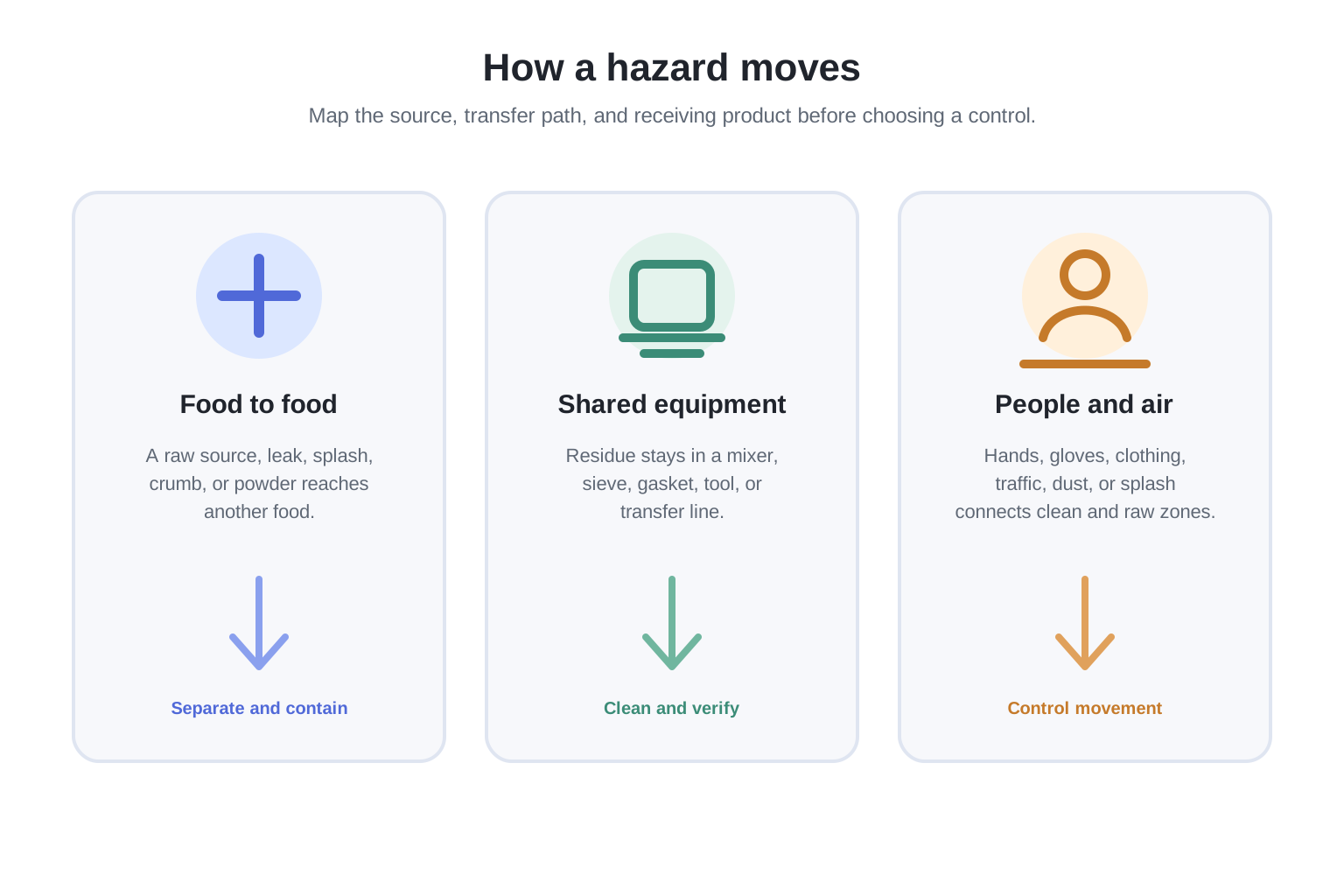
Cross-contamination describes the route, not the final result. A hazard is present at a source, then a direct or indirect connection carries it to a receiving product or surface. The receiving product may look, smell, and taste normal. That is why teams need separation, cleaning, process controls, representative testing, and records instead of relying on appearance.
In a food or supplement operation, common transfer points include:
- A raw ingredient, leak, splash, or dust cloud reaching exposed product.
- Shared mixers, mills, scoops, totes, conveyors, gaskets, or utensils carrying residue into the next run.
- Hands, gloves, clothing, forklifts, carts, or maintenance tools moving a hazard between zones.
- Rework, labels, packaging, or ingredients being added to the wrong batch.
- A sample preparation tool, bench, reagent, or container carrying material from one laboratory sample to another.
A useful working question is: What could move, where could it move, and what evidence will show that the path was controlled?
Cross-contamination, cross-contact, and contamination
The terms overlap in ordinary conversation. Quality, regulatory, and allergy teams use them more precisely because the response depends on what moved.
| Term | What it means | Example | What it changes |
|---|---|---|---|
| Contamination | A hazard is present in a food, ingredient, surface, or sample. | A botanical ingredient contains a pesticide residue. | Identify the hazard, assess the lot, and compare the result with the applicable specification or limit. |
| Cross-contamination | A hazard moves from one source to another. | A shared sieve carries powder from one lot into the next lot. | Trace the source and receiving products, then evaluate the scope of the transfer. |
| Cross-contact | An allergen protein is unintentionally introduced into food that is not meant to contain it. | Peanut residue remains in a mixer used for a peanut-free bar. | Control the allergen path, clean and verify the equipment, review labels, and make a disposition decision. |
| Sample cross-contamination | Material from one laboratory sample enters another sample or its preparation. | A high-result sample leaves residue on a spatula used for the next sample. | Preserve sample identity and investigate the laboratory process before treating the result as a product finding. |
The FDA describes allergen cross-contact as the inadvertent introduction of a major food allergen into a product. Use cross-contact in an allergen control plan, label review, or training record. It makes clear that a cooking step or microbial sanitizer does not remove the allergen protein.
How cross-contamination happens in production
Cross-contamination is easier to control when the team can see the transfer path through the whole process, from receiving to shipment and from sampling to disposition.
Ingredients and supplier flow
An ingredient can transfer a hazard before it reaches the line. Damaged cases can leak. Bulk powders can create dust when they are tipped or conveyed. A supplier can send the wrong allergen profile, an incorrect lot, or a material whose certificate of analysis does not cover the risk the brand needs to manage.
Keep raw, allergenic, non-allergenic, approved, quarantined, and rejected materials identifiable and physically separated as the risk requires. Tie supplier documents, receiving inspections, lot codes, and status changes to the material record. That gives the team a path back to the source when a finished-product result is unexpected.
Equipment, surfaces, utilities, and air
Food-contact surfaces are obvious transfer points, but the difficult areas often determine whether a control works. Hollow rollers, gaskets, seams, dead legs, valves, transfer hoses, scoops, and hard-to-clean corners can retain product or water. A conveyor can carry crumbs or allergen dust. A splash, drain, or poorly routed hose can move microbes or chemical residue. Compressed air, airflow, and people can spread dry powders beyond the intended zone.
Design and maintenance matter. The Canadian Food Inspection Agency's cross-contamination guidance calls out cross-connections, dead spots, difficult-to-clean areas, dust, traffic flow, storage, and shared equipment as factors to assess.
People, traffic, and clothing
Employees, visitors, contractors, gloves, aprons, footwear, phones, and tools can connect a raw or allergen area to an exposed finished product. A glove is a barrier only while it stays clean and is changed at the right point. A line clearance procedure fails if the team leaves old labels, scoops, or rework on the line.
Map people and material movement as part of the hazard analysis. Use designated routes, protective clothing, hand hygiene, zone controls, and clear rules for maintenance and sanitation tools. Keep the controls understandable enough that the line can follow them during a changeover or an urgent intervention.
Rework, labels, and packaging
Rework can carry an allergen, pathogen, chemical residue, or foreign material into a new formula. Incorrect labels create an allergen hazard even when the formulation is right. Packaging materials and outer cases can also move dirt or allergen dust onto an exposed contact surface.
Identify rework by product and allergen profile, define where it is allowed, and require approval before it enters a batch. Reconcile labels during line clearance and at the end of the run. A precautionary statement cannot replace controls that prevent or minimize allergen cross-contact.
Laboratory samples and preparation
A laboratory result is evidence only when the sample identity and integrity are protected. Use clean, fit-for-purpose tools and containers, control the preparation sequence, separate high-concentration or positive material when appropriate, and include blanks or other quality controls that can reveal carryover.
Sample cross-contamination can create a false positive, inflate a result, or obscure which lot generated the material. Treat the sample process as another production process with its own flow map, cleaning requirements, chain of custody, and deviation procedure.
Why the hazard determines the control
A control that works for one hazard may be irrelevant to another. Cooking can reduce many microbial hazards when the validated product and process reach the required time and temperature. It does not remove peanut protein, heavy metals, sanitizer residue, or a piece of glass. Refrigeration can slow microbial growth after a transfer, but it does not reverse the transfer.
| Hazard | Typical transfer example | Controls and evidence to consider |
|---|---|---|
| Biological | Raw material or environmental residue reaches a ready-to-eat product. | Hygienic zoning, separation, validated kill step where applicable, sanitation, environmental monitoring, product testing, and lot traceability. |
| Allergen | A shared blender carries milk, wheat, soy, peanut, or another allergen into a product without that declared ingredient. | Ingredient segregation, scheduling, validated cleaning, allergen swabs or other fit-for-purpose verification, line clearance, label controls, and changeover records. |
| Chemical | A sanitizer splash, pesticide residue, or incompatible material reaches food or supplement powder. | Chemical segregation, supplier controls, equipment design, rinse or concentration checks where applicable, targeted testing, and hold or disposition records. |
| Physical | Metal, glass, hard plastic, or other foreign material moves into product. | Equipment inspection, preventive maintenance, screens or magnets where suitable, foreign-material controls, investigation, and product scope assessment. |
The decision should follow the hazard and the exposure, not the word “contamination” alone.
Controls that prevent cross-contamination
A defensible program combines preventive controls with verification. The layers below work together.
- Map the process and hazards. Draw the flow from receiving through shipping. Mark raw and ready-to-eat zones, allergen points, rework, utilities, maintenance access, sample collection, and every step where a product changes hands. Identify the receiving product if a control fails.
- Separate by space, time, or equipment. Use dedicated lines and tools where practical. When equipment is shared, schedule compatible products, place allergen additions late in the process when possible, and run a defined changeover before the next product. Keep containers and traffic from crossing protected zones.
- Clean before you sanitize. Cleaning removes soil and product residue. Sanitizing is a separate step that reduces microorganisms under defined conditions. A sanitizer does not substitute for detergent cleaning when the concern is an allergen protein. Validate the procedure for the surface, residue, and equipment design, then verify each execution with the checks in the sanitation program.
- Control people and materials. Use handwashing, gowning, glove changes, traffic rules, dedicated utensils, and controlled maintenance practices. Store chemicals, waste, raw ingredients, and packaging so they cannot reach exposed product.
- Control suppliers, rework, and labels. Qualify suppliers based on risk, review relevant COAs, inspect incoming materials, identify lots, quarantine suspect materials, and define rework permissions. Reconcile labels and packaging at line start, changeover, and end of run.
- Monitor the environment and process. Use visual inspections, sanitation records, ATP or other hygiene indicators, allergen verification, environmental microbiology, and finished-product testing only where each method answers a defined question. ATP can indicate organic soil; it does not prove that an allergen is absent.
- Document the response. Record deviations, affected lots, holds, test results, root-cause findings, corrective actions, effectiveness checks, and final disposition. A control that happened without a record is difficult to defend during an audit or customer review.
For food facilities covered by the preventive-controls rule, 21 CFR Part 117 requires conditions and controls that minimize potential microbial growth, allergen cross-contact, and food contamination. The rule also requires effective measures to protect finished food and addresses work-in-process, rework, equipment, and testing where necessary.
How testing supports a cross-contamination decision
Testing should answer a decision question. It is not a substitute for segregation, sanitation, process control, or representative sampling.
A practical workflow looks like this:
- Name the hazard and decision. Decide whether the team is checking for a pathogen, allergen, heavy metal, pesticide, chemical residue, foreign material, or sample carryover. Set the relevant specification, action limit, customer requirement, or investigation trigger before the result arrives.
- Design a representative sample plan. Define the lot, line, zone, time, and number of samples. A single finished-product sample cannot prove that every unit, surface, or prior lot was unaffected.
- Protect sample integrity. Record the collector, location, time, lot, seal, storage, and transfer. Use clean tools, suitable containers, blanks, and segregated preparation when the risk warrants it. Keep the chain of custody with the result.
- Match method and lab to the matrix. The method needs appropriate sensitivity, specificity, recovery, and reporting limits for the product or environmental sample. An ISO 17025-accredited lab adds a documented quality system and technical competence to the analytical result.
- Hold and scope when the result requires it. Identify products made on the same line, after the same changeover, from the same ingredient lot, or with the same sample preparation. Follow the food-safety plan and quality procedure for hold, recall assessment, retest, or release.
- Investigate unexpected results. Review sample identity, preparation sequence, blanks, controls, method performance, equipment status, sanitation, environmental data, and supplier information. A retest can help answer a defined question; it should not erase the first result.
- Trend the evidence. Track results by supplier, ingredient, line, product, lot, shift, zone, and changeover. Repeated low-level findings or results after one particular process change can reveal a transfer path that a single pass or fail result hides.
A negative result applies to the sample and method used. It does not prove that every unit is free of the hazard. The strength of the conclusion depends on the sample plan, method, reporting limit, and process evidence around it.
Root-cause work after an incident
When a result or observation indicates possible cross-contamination, start with containment. Identify and hold the potentially affected material when the risk warrants it. Preserve samples, records, labels, equipment status, and relevant environmental information. Then reconstruct the path.
A useful investigation asks:
- Which source materials, products, people, equipment, rooms, and samples could have connected?
- What was made before and after the affected lot or changeover?
- Did sanitation, line clearance, traffic, rework, label, maintenance, or supplier records show a deviation?
- Were there hard-to-clean areas, leaks, dust, drainage, airflow, or shared tools?
- Could the sample or laboratory preparation have introduced the material?
- What targeted inspection or test would distinguish between the plausible routes?
Avoid closing the investigation with “operator error” unless the system conditions are also understood. A procedure that is unclear, a tool that is hard to clean, a label that looks nearly identical, or a schedule that leaves no realistic changeover time can recreate the same event.
Document corrective and preventive actions with an owner, due date, evidence of completion, and effectiveness check. Effectiveness may include follow-up sanitation verification, allergen swabs, environmental monitoring, repeat sampling, supplier action, label reconciliation, or a review of adjacent lots. The goal is to show that the transfer path was removed or reduced, not only that a single product was tested.
What compliance and release decisions require
Cross-contamination becomes a compliance issue when it can adulterate product, create an undeclared allergen, violate a specification, undermine a claim, or make a required record incomplete. The decision is usually a combination of the hazard assessment, product scope, test evidence, internal limits, customer requirements, and market rules.
For food manufacturers, FDA's allergen labeling guidance explains that Part 117 includes controls for major food allergen hazards and allergen cross-contact. FDA also says an advisory statement such as “may contain” is not a replacement for current good manufacturing practices.
For dietary supplement teams, FDA's Part 111 compliance guide describes requirements to protect components, supplements, and contact surfaces from contamination. Quality control personnel must be able to review deviations, specifications, supplier qualification, testing, and material disposition. A supplement brand remains responsible for making a defensible quality decision even when a contract manufacturer performs the production.
A certificate of analysis is one record in that system. It may show the result for one sample, method, and reporting limit. It does not prove that the sample represented the full lot, that the line was clean before production, or that a later transfer did not occur. Keep the COA connected to the lot, supplier, method, action limit, deviation, and disposition rationale.
Cross-contamination examples and matching controls
| Situation | What may have moved | Controls and evidence |
|---|---|---|
| A peanut-containing run precedes a peanut-free supplement powder on a shared blender. | Peanut protein in product residue, gaskets, or dust. | Allergen changeover procedure, validated cleaning, allergen verification, line clearance, label review, and hold or release record. |
| A raw ingredient area shares a traffic route with an exposed ready-to-eat product. | Pathogens on footwear, carts, gloves, or splashes. | Zoning, one-way traffic, protective clothing, sanitation, environmental monitoring, and scope assessment for affected lots. |
| A sanitizer container is stored beside open powder. | Chemical residue from a spill or splash. | Chemical segregation, labeled containers, spill response, equipment inspection, and targeted product or surface testing when required. |
| A high-contaminant ingredient lot is milled through common equipment before a low-spec product. | Residue retained in a mill, sieve, or transfer line. | Lot segregation, equipment design review, validated cleaning, targeted testing, trend analysis, and documented material disposition. |
| A high-result laboratory sample is prepared immediately before the next sample. | Carryover in a tool, bench, reagent, or container. | Preparation sequence, clean tools, blanks, controls, separate areas when warranted, chain of custody, and a defined laboratory deviation review. |
FAQ
Is cross-contact the same as cross-contamination?
The terms overlap. In food-allergy work, cross-contact specifically describes an allergen protein moving into food that is not intended to contain it. Cross-contamination is broader and can include biological, chemical, physical, or allergen hazards moving between foods, surfaces, people, or samples. Use the more precise term in labels, allergen plans, investigations, and training records.
Can cooking or sanitizing fix cross-contamination?
A validated cooking step can control some microbial hazards when the entire product reaches the required conditions. It does not remove allergen proteins, chemical residues, or foreign material. Sanitizing reduces microorganisms under defined conditions, while cleaning is needed to remove soil and product residues. A product can also be contaminated again after cooking if it contacts a raw product or unclean surface.
Does a negative test prove that a product is free of the hazard?
No. It supports a conclusion about the sample tested with that method and reporting limit. The confidence of a release decision also depends on sample representativeness, process controls, environmental evidence, sanitation records, and traceability.
Is a certificate of analysis enough?
No. A COA is useful evidence, especially when it includes the method, units, reporting limit, sample identity, and result. It is one part of supplier qualification and lot release. Teams also need records showing how the material was received, stored, handled, sampled, tested, and dispositioned.
What should a quality team document after a possible transfer?
At minimum, record the hazard, source and receiving products, lot codes, people and equipment involved, time window, sanitation and line-clearance records, sample chain of custody, test results, affected-lot scope, root-cause findings, corrective actions, effectiveness checks, and the person who approved final disposition.
How Light Labs supports cross-contamination decisions
We help food and supplement brands connect testing to the quality workflow. Our ISO 17025-accredited lab can support risk-based testing for contaminants, allergens, microbiology, and other product-quality questions. Our testing menu helps teams choose a panel that fits the matrix and the decision.
Our testing workflow keeps samples, COAs, action limits, retests, and supplier documents connected. The compliance platform gives quality and regulatory teams a place to review results, document disposition, and keep an audit-ready record. For supplement brands, our supplement testing support connects identity, potency, contaminants, microbiology, and compliance work.
The goal is a clear path from a suspected transfer to a defensible decision: contain the risk, investigate the route, verify the control, and release or hold the right material.
Final takeaway
Cross-contamination is the unintentional movement of a hazard from one source to another. Prevent it by mapping transfer paths, separating products and zones, cleaning before sanitizing, controlling people and materials, and protecting sample integrity. When an event occurs, connect testing to traceability, root-cause work, corrective action, and the final lot decision.
Start with Light Labs when your team needs testing and compliance records that stay connected from sample to decision.
Sources6 sources
- What is Cross-Contamination? - U.S. Department of Agriculture
- The Current Food Allergen Landscape - U.S. Food and Drug Administration
- Avoiding Cross-Contact - Food Allergy Research & Education
- Preventive Controls: Cross-contamination - Canadian Food Inspection Agency
- Prevention - Centers for Disease Control and Prevention
- Small Entity Compliance Guide: Current Good Manufacturing Practice in Manufacturing, Packaging, Labeling, or Holding Operations for Dietary Supplements - U.S. Food and Drug Administration
Whether you’re a brand or a co-manufacturer, Light Labs helps you move faster, stay compliant, and eliminate testing bottlenecks — all from a modern, shared platform.